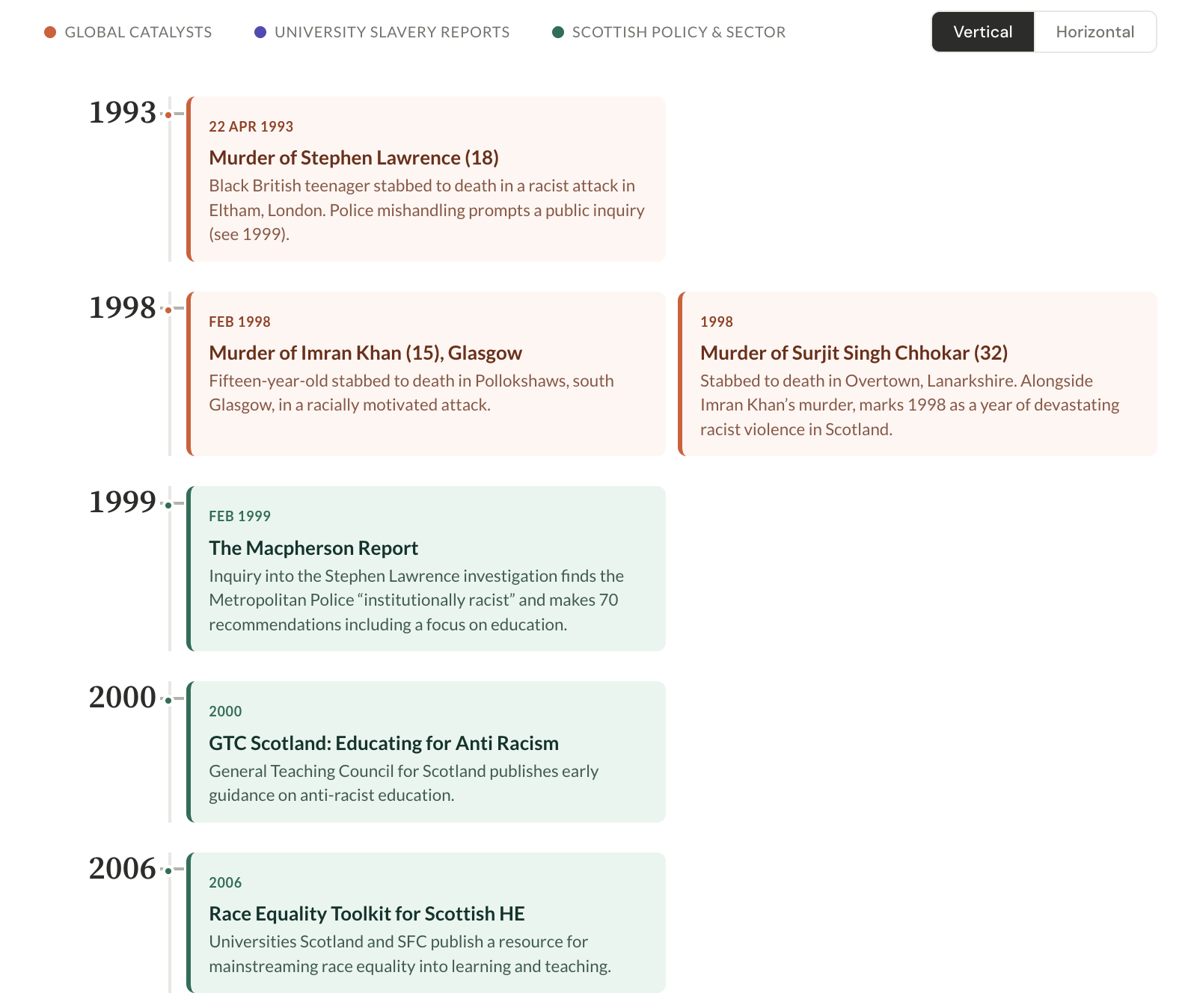
Mapping the reckoning: a timeline of Scotland's universities and slavery-derived wealth
As I was writing the literature review for my doctorate, I realized that a visual timeline might help me to understand the interconnectedness of different events. This would help me to see the different and interwoven threads of events related to anti-racism and decolonizing within higher education. This is a small, evolving snapshot.
The timeline below can be viewed in portrait or landscape mode for viewing ease. References are provided but this is a work in progress.
Produced with the assistance of Claude Opus 4 (Anthropic, 2026).
Reference list*
this is a working list and is not exhaustive*
University slavery reports
Anderson, R. (2023). Legacies of Slavery [Exhibition and research project]. University of Aberdeen. https://www.abdn.ac.uk/about/strategy-and-governance/legacies-of-slavery/
Finlay, R. (2023). Report on the University of Strathclyde's historical links to transatlantic slavery. University of Strathclyde. https://www.strath.ac.uk/whystrathclyde/news/2023/reportshedslightonhistoricallinkstotransatlanticslavery/
Fyfe, A., Robinson, I., Vancisin, T., Leith, S., & Ylitalo, M. W. (2025). The University of St Andrews and the Legacies of Empire, 1700–1900. University of St Andrews. https://doi.org/10.5281/zenodo.14975043
Gooptar, C. (2022). University of Dundee Founders Project: Final Report. University of Dundee. https://discovery.dundee.ac.uk/en/publications/university-of-dundee-founders-project-final-report
Mullen, S., & Newman, S. (2018). Slavery, Abolition and the University of Glasgow. University of Glasgow. https://www.gla.ac.uk/media/Media_607547_smxx.pdf
Research and Engagement Working Group. (2025). Decolonised Transformations: Confronting the University of Edinburgh's History and Legacies of Enslavement and Colonialism. University of Edinburgh. https://www.ed.ac.uk/about/race-review
University of Glasgow. (2019). Historic agreement sealed between Glasgow and West Indies universities [Press release, 23 August 2019]. https://www.gla.ac.uk/news/archiveofnews/2019/september/headline_667960_en.html
Policy and sector responses
Advance HE. (2015). Race Equality Charter. https://www.advance-he.ac.uk/equality-charters/race-equality-charter
CRER. (2025). Racial Inequality in Scotland: State of the Nation—Volume 1. Coalition for Racial Equality and Rights. https://static1.squarespace.com/static/615c1bee105b4f55a98326d0/t/691f27fd9b20664cbb2d97ec/1763649533269/CRER+SotN+2025+-+Volume+1.pdf
Commission on Race and Ethnic Disparities. (2021). The Report of the Commission on Race and Ethnic Disparities [The Sewell Report]. UK Government. https://www.gov.uk/government/publications/the-report-of-the-commission-on-race-and-ethnic-disparities
Equality and Human Rights Commission. (2019). Tackling racial harassment: Universities challenged. EHRC. https://www.equalityhumanrights.com/en/publication-download/tackling-racial-harassment-universities-challenged
Liyanage, M. (n.d.). Mapping the history of anti-racist curriculum work in tertiary education. AdvanceHE. Retrieved https://www.advance-he.ac.uk/sites/default/files/2021-12/Anti-Racist%20Curriculum%20Timeline%20FINAL.pdf
Macpherson, W. (1999). The Stephen Lawrence Inquiry: Report of an Inquiry by Sir William Macpherson of Cluny (Cm 4262-I). The Stationery Office. https://assets.publishing.service.gov.uk/government/uploads/system/uploads/attachment_data/file/277111/4262.pdf
Quality Assurance Agency for Higher Education. (2021). Decolonising the Curriculum in the Time of Pandemic [Collaborative Cluster]. QAA Scotland. https://www.enhancementthemes.ac.uk/resilient-learning-communities/equality-diversity-and-inclusion/decolonising-the-curriculum-in-the-time-of-pandemic
Scottish Government. (2016). Race Equality Framework for Scotland 2016–2030. https://www.gov.scot/publications/race-equality-framework-scotland-2016-2030/
Scottish Government. (2018). Teaching in a diverse Scotland: Increasing and retaining minority ethnic teachers. https://www.gov.scot/publications/teaching-diverse-scotland-increasing-retaining-minority-ethnic-teachers/
Scottish Government. (2021). Teaching in a diverse Scotland: Increasing and retaining minority ethnic teachers — 3 years on. https://www.gov.scot/publications/teaching-diverse-scotland-increasing-retaining-minority-ethnic-teachers-3-years/
Global catalysts
BBC News. (2020, June 7). Bristol George Floyd protest: Colston statue toppled. BBC News. https://www.bbc.co.uk/news/uk-england-bristol-52955868
Hill, E., Tiefenthäler, A., Triebert, C., Jordan, D., Willis, H., & Stein, R. (2020, May 31). How George Floyd was killed in police custody. The New York Times. https://www.nytimes.com/2020/05/31/us/george-floyd-investigation.html
South African History Online. (2015). University of Witwatersrand Student Protests 2015 Timeline. https://sahistory.org.za/article/university-witwatersrand-student-protests-2015-timeline
UCL Students. (2014). Why is My Curriculum White? [Video]. https://www.youtube.com/watch?v=Dscx4h2l-Pk
Racist violence, deaths in custody and asylum seeker destitution
BBC News. (2020, November 23). Sheku Bayoh inquiry: Sister tells of racist abuse as inquiry resumes. BBC News. https://www.bbc.co.uk/news/uk-scotland-63717545
Brooks, L. (2020, August 25). Mercy Baguma: Woman found dead in Glasgow flat next to crying baby. The Guardian. https://www.theguardian.com/uk-news/2020/aug/25/mercy-baguma-woman-found-dead-glasgow-flat-next-to-crying-baby
Macpherson, W. (1999). The Stephen Lawrence Inquiry (Cm 4262-I). The Stationery Office. [On the murder of Stephen Lawrence, Eltham, London, 22 April 1993]
Sheku Bayoh Public Inquiry. (n.d.). https://www.shekubayohinquiry.scot/ [On the death of Sheku Bayoh, Kirkcaldy, Fife, 3 May 2015]
Higher Education Beyond 2030: Principles, pedagogy, and the people we keep leaving out
In mid-late March 2026, I attended a session exploring the future of higher education, structured around the recently published UNESCO roadmap Transforming Higher Education: Global Collaboration on Visioning and Action (UNESCO, 2026). The room brought together academics at every career stage, from doctoral researchers to full professors, and what struck me most was not any single argument made but the collective mood: a genuine appetite for transformation sitting alongside a sober recognition of how wide the gap remains between the sector's stated values and its daily practice.
I am both a doctoral student and a university staff member, and I experience that gap from both sides simultaneously. This post is a reflection on that session and on the roadmap itself. A companion piece follows, which takes the same arguments and grounds them in the specific material conditions of Glasgow, where I work and study. What I want to do here is make the principled case about digital access, pedagogy, and whose knowledge counts, and be direct about what that case asks of educators, researchers, and policymakers.
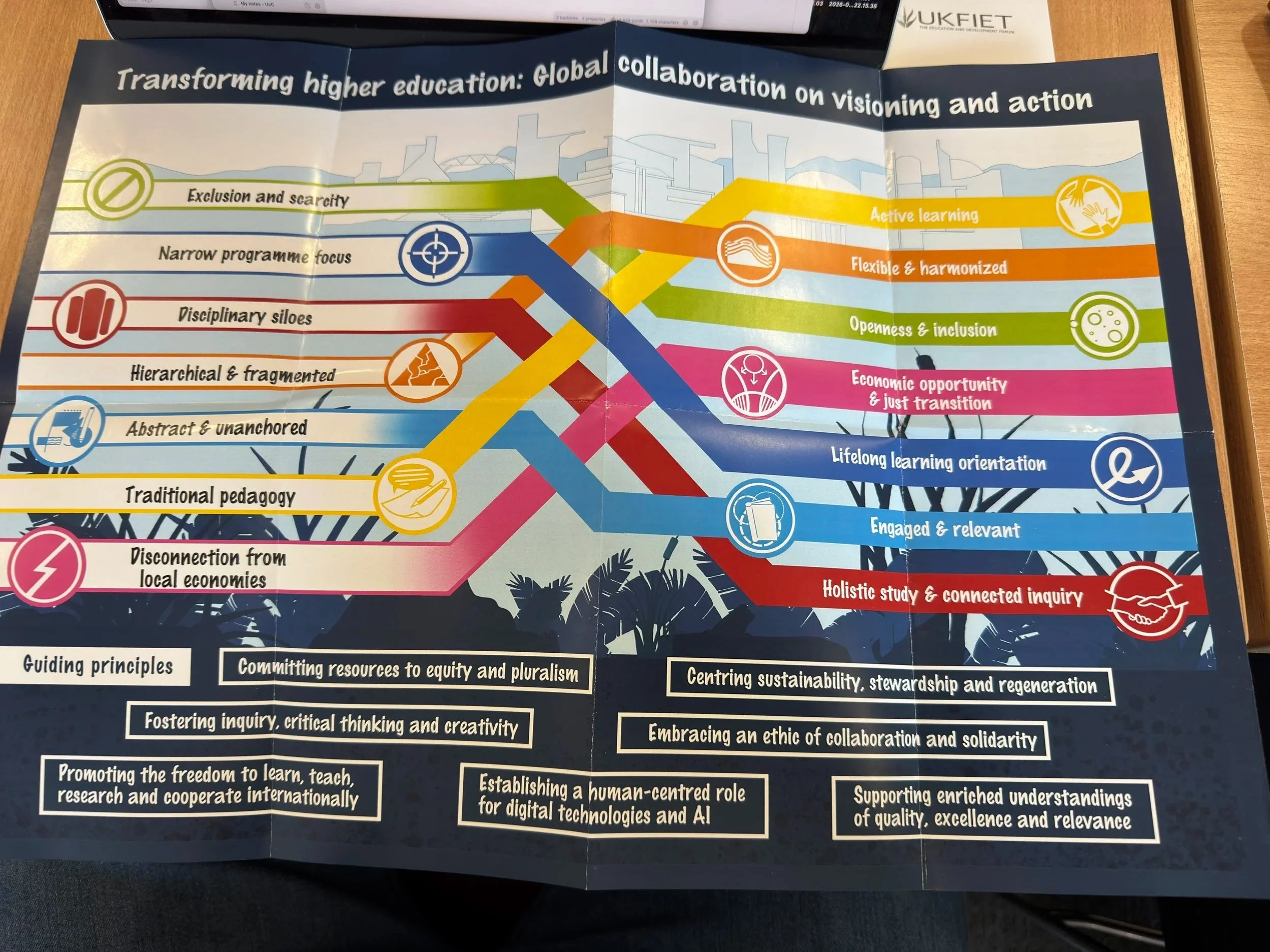
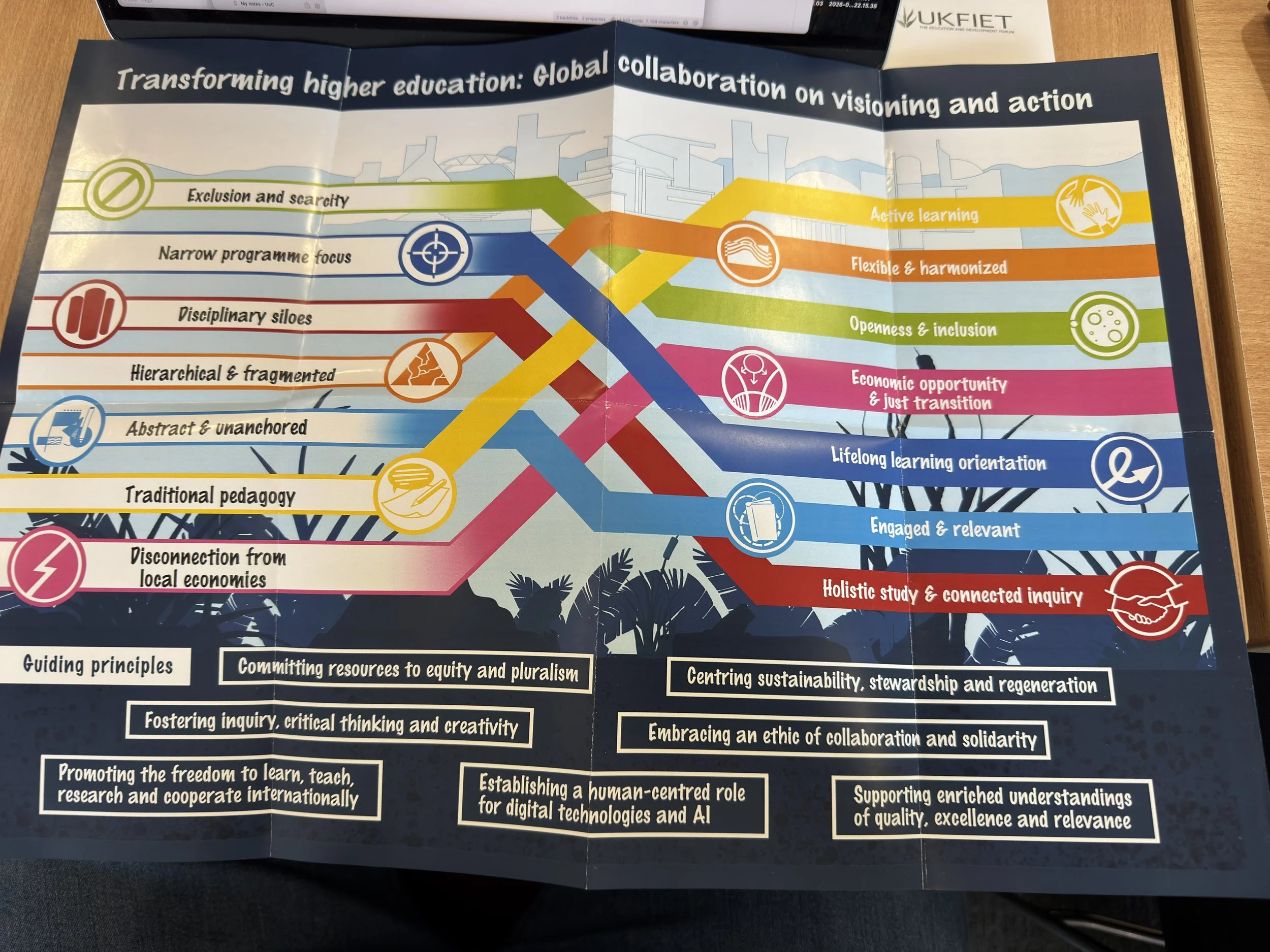
The visual from UNESCO (2026) uses a ribbon/flow diagram to map a transformation from current problems in higher education (left side) toward desired future states (right side):
Current challenges (left): exclusion and scarcity, narrow programme focus, disciplinary siloes, hierarchical and fragmented structures, abstract and unanchored learning, traditional pedagogy, and disconnection from local economies.
Transformed vision (right): active learning, flexible and harmonised systems, openness and inclusion, economic opportunity and just transition, lifelong learning orientation, engaged and relevant curricula, and holistic study and connected inquiry.
At the bottom, seven guiding principles anchor the framework: committing resources to equity and pluralism; fostering inquiry, critical thinking and creativity; promoting freedom to learn, teach, research and cooperate internationally; centring sustainability, stewardship and regeneration; embracing an ethic of collaboration and solidarity; establishing a human-centred role for digital technologies and AI; and supporting enriched understandings of quality, excellence and relevance.
Guiding principles to reshape the future of higher education (UNESCO, 2026)
The roadmap proposes seven guiding principles that are interlinked and mutually reinforcing:
Committing resources to equity and pluralism.
Promoting the freedom to learn, teach, research and cooperate internationally.
Fostering inquiry, critical thinking and creativity.
Establishing a human-centred role for digital technologies and artificial intelligence
Embracing an ethic of collaboration and solidarity.
Centring sustainability, stewardship and regeneration.
Supporting enriched understandings of quality, excellence and relevance.
The document and what it is asking of us
The UNESCO roadmap is the outcome of a remarkable consultative process: over 15,000 participants, more than 1,500 comments on a draft roadmap, and 250 knowledge products submitted from across the world. It sets out seven guiding principles and a set of lines of transformation intended to move higher education toward what it calls a new social contract. The principles call for committing resources to equity and pluralism; promoting the freedom to learn, teach, research, and cooperate internationally; fostering inquiry, critical thinking, and creativity; establishing a human-centered role for digital technologies and AI; embracing an ethic of collaboration and solidarity; centering sustainability, stewardship, and regeneration; and supporting enriched understandings of quality, excellence, and relevance (UNESCO, 2026).
What the session made clear is that many people working in higher education find these principles genuinely compelling. The hunger for a more collaborative, more inclusive, and more epistemically honest sector is real and broadly shared. What is less clear is whether institutions, as opposed to the individuals within them, are prepared to act on these principles when doing so would cost something: revenue, convenience, prestige, or the comfort of familiar ways of working.
Digital access as an equity question, not a technical one
The roadmap is explicit that enriching higher education with "the possibility to study online and/or in hybrid formats would open higher education to more diversified learner motivations and interests, as well as to those who pursue it alongside full-time employment or care work" (p. 41). It also recognizes that "students can learn in different settings and spaces, whether that be in workplaces, in communities, or different cultural settings" (p. 41).
These are not technical observations about learning management systems. They are equity arguments. And yet across the sector, a counter-movement is underway. Universities that expanded hybrid and online provision during the pandemic, often discovering in the process that engagement did not collapse and that participation from previously excluded groups increased, are now reverting to in-person-only defaults. The rationale is rarely made explicit. When it is, it tends to appeal to the value of campus community, the richness of in-person dialogue, or concerns about student isolation. These are not trivial considerations. But they are being invoked selectively, in ways that consistently favor the preferences of those for whom in-person attendance is easy over those for whom it is costly or impossible.
The roadmap's call to move from "a scarcity and exclusion mindset to an openness and inclusion paradigm" (p. 35) applies here directly. Decisions about session formats, whether a seminar, a meeting, a public lecture, or a research event is offered in hybrid form or in-person only, are not logistical defaults. They are choices about whose participation the institution is prepared to resource and whose it is prepared to make contingent on circumstances that are not equally distributed. For educators, this means thinking carefully about the assumptions embedded in format decisions that are often made without much thought at all. For policymakers, it means recognizing that guidance on hybrid provision, and the resourcing to support it properly, has not kept pace with the rhetoric of inclusion.
Collaborative assessment and the gap between what we teach and what we test
The roadmap calls for pedagogical approaches to move away from "traditional listen-and-repeat methods" and toward active, problem-based, and project-based learning. It argues that "significant learning experiences often begin with a genuinely felt problem motivating the learner" and that student-centeredness means "involving learners in their own learning, so they are the ones making connections and shaping meaning" (p. 45). The document describes the overarching aim of higher education as building "collective and individual capacities for facing our common challenges together" (p. 29).
The conversations in our session pointed to strong agreement with this direction. And yet the dominant model of assessment in higher education remains resolutely individual. Students may be invited to collaborate in seminars, workshops, and project groups. But when grades are assigned, it is nearly always the individual who is evaluated. The group is, in practice, a scaffold for solo performance.
This is not a minor inconsistency. It sends a clear signal to students about what the institution actually values, regardless of what it says about collaboration, communication, and citizenship. If we believe, as the roadmap argues, that higher education's purpose is to build people who can face shared challenges together, then assessing them only as isolated individuals is a structural contradiction at the heart of the enterprise.
The objection that collaborative assessment is difficult to do fairly is real but insufficient. These are design problems, and they are solvable. What they require is institutional will: the willingness to invest in assessment literacy among staff, to create conditions for genuine pedagogical experimentation, and to accept that the discomfort of change is not a reason to preserve a model that is increasingly misaligned with the capabilities higher education claims to develop. For researchers, this is an area where practice-based educational research can make a direct contribution. For policymakers, it is an area where quality frameworks and professional standards could do more to reward innovation in assessment design rather than defaulting to the legibility of individual grades.
Decolonization and the question of whose knowledge counts
Perhaps the most resonant theme of the session was the need to take seriously the decolonization of knowledge: not as a metaphor, a branding exercise, or a curriculum add-on, but as a fundamental rethinking of whose ways of knowing are recognized, valued, and built upon in higher education.
The roadmap is direct about this. It acknowledges that "the claims of local and indigenous knowledge systems are increasingly prevalent, with voices from the global south dismantling knowledge gatekeeping" (p. 17), and calls for universities to engage with "plural forms of knowing as these are practiced by various communities around the globe" (p. 23). In its sixth guiding principle, it calls for research and scholarship to be "democratized, decolonized and disseminated to serve the common good" (p. 31). It argues that universities must go beyond respect and tolerance to ensure that "heterogenous ways of knowing and being become a welcome and respected foundation for building futures together" (p. 23).
For educators, this demands more than adding readings from the Global South to an otherwise unchanged curriculum. It requires examining the epistemic assumptions embedded in how disciplines are structured, what counts as rigorous methodology, which citations carry authority, and whose theoretical frameworks are treated as universal while others are marked as regional or merely applied. These are uncomfortable questions for many established academics, precisely because they put the foundations of expertise under scrutiny rather than merely its contents.
For policymakers, the decolonization agenda has implications for hiring practices, research funding priorities, quality assurance frameworks, and the governance structures of universities themselves. Institutions that talk about decolonization without addressing who sits on their hiring panels, whose research agendas attract institutional investment, and how their quality metrics are constructed are engaging in a form of performativity that the roadmap is trying to move us beyond.
Crucially, as I argue in the companion piece, epistemic justice and material justice are not separable. The question of whose knowledge is centered in a curriculum cannot be fully addressed while the question of who can afford to show up to engage with it remains unresolved. Universities are simultaneously asking people to think more expansively about knowledge while making the conditions of intellectual participation materially harder for precisely the communities whose perspectives the curriculum most needs.
A note on institutional culture and the cost of belonging
There is a question worth putting to any institution that claims to take equity seriously: what does it cost someone to spend a day on your campus? Not in tuition or fees, but in the accumulated small expenditures, transport, food, a hot drink, that constitute the texture of belonging. The answer varies considerably across institutions and across the sector, and the variation is not random. It tends to reflect how seriously an institution has thought about whose comfort and whose finances it has designed itself around.
For policymakers and institutional leaders, this is worth attending to. The grand language of transformation in documents like the UNESCO roadmap finds its test not only in curriculum reform or strategic plans but in the daily, material conditions of the people the institution is supposed to serve. I take this up in much more concrete terms in the companion piece, which looks specifically at Glasgow.
Calls to action
For educators: examine the assumptions embedded in your default practices. When you schedule an in-person-only session, ask who that decision excludes and whether the exclusion is pedagogically justified. When you design an assessment, ask whether it tests the capabilities you claim to value or merely the ones that are easiest to grade individually. When you design or teach a course, ask whose knowledge its theoretical foundations are built on and whether that foundation is as universal as it has been presented.
For researchers: the gap between the transformative agenda the UNESCO roadmap describes and the practices of actual institutions is a rich and urgent site for educational research. Work that documents the equity impacts of hybrid provision decisions, evaluates collaborative assessment models, and traces the relationship between material precarity and epistemic participation is directly actionable. It does not need to wait for the sector to catch up. It can help create the conditions for it to do so.
For policymakers: the seven principles in the UNESCO roadmap are only as meaningful as the frameworks, funding mechanisms, and accountability structures that support them. Guidance on hybrid provision, investment in integrated transport where universities are anchor institutions, reform of quality frameworks to reward pedagogical innovation, and serious attention to student financial support are not peripheral concerns. They are the infrastructure on which the new social contract the roadmap calls for either stands or falls.
The roadmap closes with the observation that "transforming higher education will always be an iterative, ongoing, multilateral and intergenerational process" (p. 55). That is true. It is also, if we are not careful, a way of making peace with the distance between vision and practice. The question is not whether transformation is possible. It is whether we are prepared to begin it, seriously, now.
A companion piece, focusing on what these arguments look like in the specific context of Glasgow, its housing emergency, its fragmented transport system, and the daily material conditions of the students and staff who make up its universities, follows shortly.
References & further information
UNESCO. (2026). Transforming higher education: Global collaboration on visioning and action.
Launch event for the roadmap
A snapshot of what the document is about