
The real cost of higher education: Glasgow, inequality, and the universities in our midst
This piece is a companion to "Higher Education Beyond 2030: Principles, pedagogy, and the people we keep leaving out," which makes the principled case for transformation drawing on the UNESCO roadmap.
I am a doctoral student and a university staff member working in higher education, and living in Glasgow. I attend sessions about the future of the sector, read the policy documents, and engage seriously with arguments about transformation, inclusion, and epistemic justice.
I also travel to and from two campuses in a city where average private rents rose by 6.1% in a single year, where Glasgow City Council declared a housing emergency in November 2023, and where, according to NUS Scotland's own survey data, over half of students in Scotland have skipped a meal because of a lack of money.
This piece is a companion to a reflection I wrote on the UNESCO roadmap Transforming Higher Education: Global Collaboration on Visioning and Action (UNESCO, 2026) and on a recent session I attended exploring its implications. That piece made the principled arguments about digital access, collaborative pedagogy, and decolonization. This one asks what those principles look like when set against the material conditions of a specific city and the people who live, study, and work in it.
The intended audience here is different from the companion piece. This is not primarily addressed to educational theorists or senior policymakers, though they are welcome. It is addressed to students who are wondering whether their institution is on their side. To staff who are navigating the same city with the same pressures and less institutional support than they deserve. To members of the public who live alongside Glasgow's universities and have a stake in what those universities do and how they do it. And to policymakers who need to hear, in plain terms, what the gap between rhetoric and reality currently looks like
The city these universities are in
Glasgow is home to three major universities and a School of Art, with a student population that has grown by more than 20,000 over the last decade (Urban Living News, 2025). It is also a city in a housing emergency. Glasgow City Council declared that emergency in November 2023 after councillors agreed that pressures on homelessness services had become impossible to manage without formal acknowledgment (Glasgow City Council, 2023). The Scottish Housing Regulator had warned in February 2023 of an emerging risk of systemic failure. By December 2023, it had concluded that a systemic crisis in homelessness services was underway across Scotland (Glasgow Guardian, 2026).
The numbers behind that emergency are visible in the data. According to the Office for National Statistics, average private rents in Greater Glasgow reached £1,273 per month in January 2026, a 6.1% annual increase that significantly outpaced the Scottish average rise of 2.6% over the same period (ONS, 2026). Average rents for a one-bedroom property stand at £838 per month; for a flat or maisonette, £1,010. Average house prices in Glasgow reached £189,000 in December 2025, up 4.8% year on year, with first-time buyers paying an average of £171,000 (ONS, 2026). These are not abstract figures. They describe the market that students, early-career researchers, sessional teaching staff, and professional services workers are trying to navigate on incomes that have not kept pace.
It is worth flagging a distinction here. The ONS rental figures reflect the broad private rental market across Greater Glasgow. Student shared accommodation, while cheaper on average, has followed the same upward trajectory. Estimates for shared student housing in Glasgow range from around £350 to £500 per month per person (UniNist, 2025), but these figures predate the most recent rent increases and should be understood as a floor rather than a reliable current average. A report by the Chartered Institute of Housing found a shortfall of over 6,000 student bed spaces in Glasgow alone (Property118, 2024), meaning that many students are competing for housing in the general private rental market rather than the more sheltered student sector.
When students cannot find affordable housing near campus, the consequences are not merely inconvenient. Reports showed students at one of Glasgow's major universities placed in emergency accommodation when they could not secure housing in time for the start of term. Others commuted long distances or sofa-surfed while attending lectures (Glasgow Guardian, 2026; UK Collaborative Centre for Housing Evidence, 2024). A survey found that 57% of students in Glasgow felt their university offered no support to address the cost of living crisis, placing Glasgow second among UK cities for perceived lack of university support (The Tab, 2023).
What the data says about daily survival
NUS Scotland's 2023 report Fighting for Students: The Cost of Survival, based on a survey of over 5,300 students and apprentices across Scotland conducted in November 2022, sets out what these conditions mean in practice (NUS Scotland, 2023). It is worth stating these figures plainly: 52% of students surveyed had skipped a meal due to lack of money; 45% had gone without heating; 35% had been unable to pay their rent in full at some point; 12% had experienced homelessness during their studies, with 2% homeless at the time of the survey; 11% had used a food bank; and over a third had considered dropping out for financial reasons, with the cost of living cited by one in five of those who had considered leaving.
Two thirds of students reported that their mental health had been affected by worrying about money. Three in five were working alongside their studies, many of them in part-time jobs of ten to twenty hours per week, taken on not for career development but to cover rent, food, and transport (NUS Scotland, 2023).
This data is now over three years old and was collected before the most recent rounds of rent increases reflected in the ONS figures cited above. The conditions it describes have in all probability worsened since. These figures are not a historical snapshot of a crisis that has passed. They are a baseline for a situation that has continued to deteriorate.
Widening access students, those from low-income backgrounds, care-experienced students, estranged students, disabled students, and students with caring responsibilities, were consistently more likely to appear at the sharp end of every one of these measures (NUS Scotland, 2023). These are the students who are most likely to have been the first in their families to enter higher education, who carry the highest stakes in being here, and who are being asked to succeed in an environment that is materially stacked against them in ways their more affluent peers simply do not experience.
The cost* of getting there
Regarding costs*, I have done an online search for local costs as of March 2026; some of these numbers may be incorrect, as, from personal observation, bus/subway/train prices can and do change at short notice.
The question of transport sits at a particular intersection of the city's inequalities and the choices universities make about how they deliver their teaching and events.
When students and staff are priced out of living near campus, they travel in from further away. When they travel in from further away, they pay more to get there. And when a university decides that a seminar, a meeting, a lecture, or a research event will be in-person only, which is increasingly common as institutions pull back from hybrid provision expanded during the pandemic, it is making a financial demand on people whose financial position it has not accounted for.
Scotland's under-22s free bus travel scheme is a genuinely important policy. Every person aged between 5 and 21 living in Scotland can travel on almost all scheduled bus services for free using a National Entitlement Card (Transport Scotland, 2024). For younger undergraduates, this is real and meaningful support. But the scheme has limits that matter enormously in a university context. It does not cover the subway. It does not cover trains. It applies to buses only, and it ends at 22. Most postgraduate students, doctoral researchers, mature undergraduates, sessional teaching staff, early-career researchers, and professional services workers fall entirely outside it. As someone who is both a doctoral student and a staff member, I am in the position of navigating this daily. NUS Scotland made the logical extension of this policy explicit in their recommendations, calling for free bus travel to be extended to all students regardless of age (NUS Scotland, 2023). That extension has not happened.
For those outside the scheme, the costs are specific and cumulative. On the subway, a contactless single costs £1.80 and a contactless all-day ticket costs £3.40. For those buying paper tickets at the station, a return costs £3.50 and an all-day paper ticket costs £4.45 (SPT, 2026). First Bus adult singles in Greater Glasgow start from £2.45 and rise to £7.05 depending on the zone, with a four-week City/Local pass at £85 and a four-week Network pass at £110 (First Bus, 2026). For anyone combining bus and subway, or travelling by train from beyond the city boundary, these costs compound. A single outward journey into campus using multiple modes can reach £5 to £9, and that is before the return trip.
Unlike London's Oyster system or the West Midlands' Swift card, Glasgow does not have a unified multi-operator ticketing system. SPT's Zonecard offers some integration, but it does not cover all operators, and many commuters end up paying separately for each mode of travel. There is no single tap-in, tap-out system that makes cross-modal travel predictable or simple. The result is a transport landscape that is fragmented, expensive in aggregate, and most punishing for those who live furthest from campus. Given the housing market described above, that increasingly means those who can least afford to live close.
Consider a postgraduate student or a sessional staff member living in Rutherglen or Paisley, outside the free bus travel scheme, who is asked to come in for a one-hour meeting that could be held online. That journey costs them somewhere between £5 and £9 each way. It may take 45 minutes each way. For someone working part-time alongside their studies or on a fractional contract, this is not a minor inconvenience. It is a financial and logistical burden that adds up across a semester. When institutions make in-person attendance the default without examining these conditions, they are not making a neutral pedagogical choice. They are imposing a cost on the people least able to carry it.
Once you are there: what on-campus prices signal
I want to make an observation based on my own experience working at and visiting universities in Glasgow, and I want to be clear that it is my own observation rather than a sourced finding. Across Glasgow's three largest universities, the cost of a cup of coffee or tea at campus cafes varies from around £1.40 to over £2.50 for essentially the same product, in the same city, within a short distance of each other.
For a student who has gone without heating, who is working fifteen hours a week on top of their studies, and who has just paid £5 or more to get to campus, the cost of a hot drink is one more calculation in a day already full of them. The variation in pricing across the city's universities is not explained by differences in operating costs. It reflects institutional choices about whose comfort matters and who is expected to subsidize the institution's catering operation.
This is not a trivial point dressed up as a serious one. It is a legible signal, visible to every student and member of staff who uses these spaces every day, about whose interests the institution has designed itself around. In the first of these two pieces, I framed this more abstractly as a question about institutional culture and the cost of belonging. Here I am being more direct: universities that take student and staff wellbeing seriously price their campus services to reflect that. Those that do not are making a choice, and the people paying the price are the ones who can least afford it.
Decolonization and the cost of participation
The session that prompted these two pieces included significant conversation about decolonizing the curriculum: bringing in pluriversal knowledge traditions, recognizing epistemologies that have been marginalized or suppressed, and building higher education on a genuinely broad understanding of what knowledge is and where it comes from.
Glasgow's universities have a particular obligation to have this conversation honestly. These are institutions built in part on the wealth of empire, operating in a diverse and internationally connected city, serving student populations that include people from communities whose knowledge traditions have historically been either ignored by or actively extracted from Western academic institutions.
But here is what the data makes unavoidable. The NUS Scotland report shows that widening access students, those from low-income backgrounds, care-experienced students, estranged students, and disabled students, are consistently the most likely to have skipped meals, gone without heating, experienced homelessness, and considered dropping out (NUS Scotland, 2023). These groups include many, though not all, of the students from communities whose perspectives and knowledge traditions the decolonization agenda most needs in the room. If those students are surviving at a level of material precarity that makes full intellectual engagement structurally difficult, then the curriculum conversation is happening without the people it most needs. You cannot decolonize a room that not everyone can afford to enter.
This is not an argument for deferring the curriculum conversation until material conditions improve. It is an argument for recognizing that they are the same conversation. Epistemic justice and material justice are not separable. The question of whose knowledge is centered in higher education cannot be resolved while the question of who can afford to show up remains open.
What needs to change and who needs to change it
For students: the conditions described in this piece are not the result of your individual failure to manage your finances. They are structural, they are documented, and they are contested. NUS Scotland's recommendations, extending free travel to all students regardless of age, a student rent freeze, increases in grants and bursaries to real living wage levels, are specific, costed, and achievable (NUS Scotland, 2023). Know what you are owed. Use your students' association. Make demands of your institution and of the Scottish Government, because the evidence base to support those demands is already there.
For staff: many of you are navigating versions of the same pressures, particularly those in sessional, part-time, or early-career roles. The fragmented transport system, the rising rents, the question of whether it is financially rational to come in for a single meeting are not only student concerns. They are workplace conditions, and they are worth raising through trade unions, through staff governance structures, and in direct conversations with institutional leadership about how hybrid working policies are designed and applied.
For members of the public: Glasgow's universities are not separate from the city. They are anchor institutions that shape its housing market, its transport patterns, its cultural life, and its economic geography. When a university expands its student intake without attending to the housing consequences, or prices its campus services above what its own students can afford, or reverts to in-person-only provision without examining who that excludes, these are not internal institutional matters. They are decisions with consequences for the city and its communities, and the public has a legitimate interest in them.
For policymakers: the evidence is here and it is not new. Extending free bus travel to all students regardless of age is a direct and achievable intervention. A serious student housing strategy, not a collection of aspirations but a funded and enforceable plan, is overdue. Investment in a genuinely integrated, multi-modal public transport ticketing system for Glasgow would benefit students, staff, and the wider public simultaneously. And guidance to universities on hybrid provision, framed explicitly as an equity issue rather than an operational preference, would cost relatively little and make a material difference to the people currently being asked to absorb costs the institution has not accounted for.
The UNESCO roadmap I referenced in the companion piece argues that higher education "creates social wealth and builds shared value" (p. 9). That is a vision worth working toward. But social wealth is not created by institutions that ask the least-resourced members of their community to bear the greatest costs of participation. It is created by institutions that take seriously what it actually costs to belong.
This piece is a companion to "Higher Education Beyond 2030: Principles, Pedagogy, and the People We Keep Leaving Out," which makes the principled case for transformation drawing on the UNESCO roadmap.
References
First Bus. (2026). Ticket prices: Greater Glasgow. https://www.firstbus.co.uk/greater-glasgow/tickets/ticket-prices
Glasgow City Council. (2023). Glasgow declares housing emergency. https://www.glasgow.gov.uk/article/7848/Glasgow-declares-housing-emergency
Glasgow Guardian. (2026, March 1). Locked out: Glasgow's housing crisis. https://glasgowguardian.co.uk/2026/03/01/locked-out-glasgows-housing-crisis/
NUS Scotland. (2023). Fighting for students: The cost of survival. https://assets.nationbuilder.com/nus/pages/358/attachments/original/1676990009/NUS_Cost_of_living_Crisis_presentation_reduced.pdf
Office for National Statistics. (2026, February 18). Housing prices in Glasgow. https://www.ons.gov.uk/visualisations/housingpriceslocal/S12000049/
Property118. (2024). Students struggle as Scottish housing crisis worsens. https://www.property118.com/students-struggle-as-scottish-housing-crisis-worsens/
Scottish Housing News. (2023, December 1). Housing emergency declared in Glasgow. https://www.scottishhousingnews.com/articles/housing-emergency-declared-in-glasgow
Strathclyde Partnership for Transport. (2026). Subway tickets. https://www.spt.co.uk/tickets/subway-tickets/
The Tab. (2023, August 28). Glasgow ranks second for student living costs in the UK. https://thetab.com/2023/08/28/glasgow-ranks-second-for-student-living-costs-in-the-uk
Transport Scotland. (2024). Young persons' (under 22s) free bus travel. https://www.transport.gov.scot/concessionary-travel/under-22s-free-bus-travel
UK Collaborative Centre for Housing Evidence. (2024, March 14). A struggle for a place to call home: Glasgow student housing. https://housingevidence.ac.uk/a-struggle-for-a-place-to-call-home-glasgow-student-housing/
UniNist. (2025). Cost of living in Glasgow 2025. https://uninist.com/blog/financial-planning/cost-of-living-in-glasgow-2025
Urban Living News. (2025, February 24). Glasgow student shortfall passes 6,000 beds. https://urbanliving.news/news/glasgow-student-shortfall-passes-6000-beds/
UNESCO. (2026). Transforming higher education: Global collaboration on visioning and action. https://doi.org/10.54675/SNJW1822
Critical AI Engagement Framework
NB: This page was original published 24 March 2026, and has since been updated on 21 May 2026 to reflect the latest framework iteration (Version 1.4). A further update was made on 26 August to add the interactive version of the framework, available on a separate page.
This framework draws on Hosseini's (2026) forthcoming paper in The Geographical Journal, which examines how generative AI tools reproduce racial, gendered, and class-based representations through algorithmic coloniality (Mohamed et al., 2020). That work demonstrates how seemingly neutral prompts encode dominant cultural assumptions, producing outputs that reflect and reinforce existing inequalities.
The Critical AI Engagement Framework extends this analysis into a practical pedagogical tool, mapping how individuals engage with generative AI across two axes: epistemic posture and structural consciousness. It is designed for use across educational contexts, supporting educators and learners in moving beyond prompt refinement toward critical, collective, and structurally informed engagement with AI systems.
April 2026 update: the paper informing this framework has now been published and is available below.
May 2026 update: version 1.4 of the framework is towards the end of this page.
August 2026 update: you can find an interactive and mobile-friendly version fo the Critical AI Framework at the following page.
Hosseini, D. D. 2026. “Generative AI: A Problematic Illustration of the Intersections of Race, Gender and Class.” The Geographical Journal 192, no. 2: e70085. https://doi.org/10.1111/geoj.70085.
Generative AI tools are now embedded in higher education, used to draft text, generate images, produce code, and synthesise research. Yet these tools are not neutral. They encode the assumptions, hierarchies, and exclusions of the data they were trained on, reproducing patterns of racial, gendered, and class-based harm even as their outputs become more sophisticated (Benjamin, 2019; Mohamed et al., 2020; Noble, 2018). Understanding how students engage with these tools, and what that engagement does or does not interrogate, is therefore an urgent task for educators.
The Critical AI Engagement Framework maps educational engagement with generative AI across two axes. The horizontal axis describes an individual’s epistemic posture toward AI: from treating its outputs as authoritative, through questioning them, to recognising the colonial and structural conditions that shape what AI knows, whose knowledge it centres, and what it silences (Hosseini, 2026; Maalsen, 2023). The vertical axis describes how far an individual recognises AI as a socio-technical artefact shaped by relations of power, rather than simply a tool with fixable flaws (Benjamin, 2019; Quijano, 2000; Zembylas, 2023). The positions individuals occupy are not freely chosen but reflect the institutional, curricular, and social conditions that shape how they learn and work. The framework’s aspiration is not a more capable individual user but collective action: sustained, community-grounded engagement that works toward structural change (Camacho Felix, 2025; Mohamed et al., 2020).
neutral & apolitical
lacks systemic account
coloniality & harm
Critical AI Engagement Framework Version 1.4
This version adds in the researcher lens and concepts such as epistemic accountability and the research lifecycle.
Generative AI tools are now embedded in higher education, used to draft text, generate images, produce code, and synthesise research. Yet these tools are not neutral. They encode the assumptions, hierarchies, and exclusions of the data they were trained on, reproducing patterns of racial, gendered, and class-based harm even as their outputs become more sophisticated (Benjamin, 2019; Mohamed et al., 2020; Noble, 2018). Understanding how students engage with these tools, and what that engagement does or does not interrogate, is therefore an urgent task for educators.
The Critical AI Engagement Framework maps educational engagement with generative AI across two axes. The horizontal axis describes an individual’s epistemic posture toward AI: from treating its outputs as authoritative, through questioning them, to recognizing the colonial and structural conditions that shape what AI knows, whose knowledge it centers, and what it silences (Hosseini, 2026; Maalsen, 2023). The vertical axis describes how far an individual recognizes AI as a socio-technical artefact shaped by relations of power, rather than simply a tool with fixable flaws (Benjamin, 2019; Quijano, 2000; Zembylas, 2023). The positions individuals occupy are not freely chosen but reflect the institutional, curricular, and social conditions that shape how they learn and work. The framework’s aspiration is not a more capable individual user but collective action: sustained, community-grounded engagement that works toward structural change (Camacho Felix, 2025; Mohamed et al., 2020).
neutral & apolitical
lacks systemic account
coloniality & harm
This view reframes the framework for researchers engaging with generative AI across the research process. The two applied sections in each cell address the researcher's own practice and the dimension of epistemic accountability — a concept that holds together citational justice (the obligation to credit ideas and intellectual labour whether or not they appear in a formal reference list) and research integrity (the obligation to be transparent about the conditions, limitations, and role of AI in knowledge production). Together they ask: is this knowledge claim accountable — to its sources, its methods, and the communities it draws on?
Positions are not fixed. A researcher may occupy different cells across different phases of the research lifecycle, and across different relationships — with their own field, with collaborators, with communities whose knowledge they draw on.
neutral & apolitical
lacks systemic account
coloniality & harm
This view adds epistemic accountability as a fourth dimension alongside the original three sections. Epistemic accountability holds together two obligations that AI use makes newly urgent: citational justice — recognising whose ideas are absorbed through AI-mediated synthesis and naming intellectual contributions that fall outside formal citation conventions — and research integrity — being transparent about the conditions, limitations, and role of AI in knowledge production. Neither subordinates the other. Citational justice asks whose labour is acknowledged; research integrity asks whether the conditions of production are honestly disclosed. Together they ask: is this knowledge claim accountable — to its sources, its methods, and the communities it draws on?
This view preserves the educational framing (theoretical anchor, for educators, for students) and adds epistemic accountability as a cross-cutting dimension that applies regardless of whether the user is a researcher, educator, or student. AI use in educational contexts raises the same questions of intellectual credit, attribution transparency, and relational accountability as it does in formal research.
neutral & apolitical
lacks systemic account
coloniality & harm
This view maps AI engagement across the research lifecycle, tracing how epistemic posture — from deference to collective agency — manifests differently at each phase of research practice. Each phase carries distinct risks and possibilities: the literature and framing phase is where AI most aggressively shapes what counts as relevant scholarship; methodology and design is where colonial defaults in AI recommendations become embedded in the research architecture; data and evidence is where AI's training hierarchies most directly affect what gets surfaced and what gets buried; analysis and interpretation is where AI can flatten the conceptual moves that distinguish critical from descriptive work; writing and synthesis is where citational erasure is most invisible; and publication and dissemination is where structural change is most possible — and most resisted.
The epistemic accountability dimension (gold) runs through all phases but intensifies toward dissemination. It addresses two obligations simultaneously: citational justice — whose intellectual labour is acknowledged, including named authors, unnamed collaborators, community knowledge, conversations, and ideas that circulate before they are published — and research integrity — transparent disclosure of how AI was used, what it could not see, and what structural conditions shaped the knowledge produced. Both are present at every phase; the balance between them shifts as the research progresses.
The phase where AI most aggressively determines whose scholarship counts as foundational. Epistemic deference here shapes the entire conceptual architecture of the research.
AI methodology recommendations embed epistemological defaults — which methods count as rigorous, whose frameworks are treated as standard — that shape what the research can find before data collection begins.
AI's training hierarchies directly affect what gets surfaced and what gets buried. At this phase, algorithmic coloniality is most materially consequential — shaping whose experiences, voices, and data are treated as valid evidence.
AI analysis flattens complexity and forecloses interpretive possibilities. The conceptual moves that distinguish critical from descriptive research are most at risk here — as AI tends toward synthesis, consensus, and the resolution of tension.
Citational erasure is most invisible at this phase. AI-assisted writing absorbs ideas, framings, and formulations without tracing them to their origins — and researchers may not notice because the output reads as their own.
The phase where structural change is most possible and most resisted. Publishing choices — venue, format, access, co-authorship conventions — are themselves political acts that reproduce or challenge the knowledge hierarchies AI encodes.
Higher Education Beyond 2030: Principles, pedagogy, and the people we keep leaving out
In mid-late March 2026, I attended a session exploring the future of higher education, structured around the recently published UNESCO roadmap Transforming Higher Education: Global Collaboration on Visioning and Action (UNESCO, 2026). The room brought together academics at every career stage, from doctoral researchers to full professors, and what struck me most was not any single argument made but the collective mood: a genuine appetite for transformation sitting alongside a sober recognition of how wide the gap remains between the sector's stated values and its daily practice.
I am both a doctoral student and a university staff member, and I experience that gap from both sides simultaneously. This post is a reflection on that session and on the roadmap itself. A companion piece follows, which takes the same arguments and grounds them in the specific material conditions of Glasgow, where I work and study. What I want to do here is make the principled case about digital access, pedagogy, and whose knowledge counts, and be direct about what that case asks of educators, researchers, and policymakers.
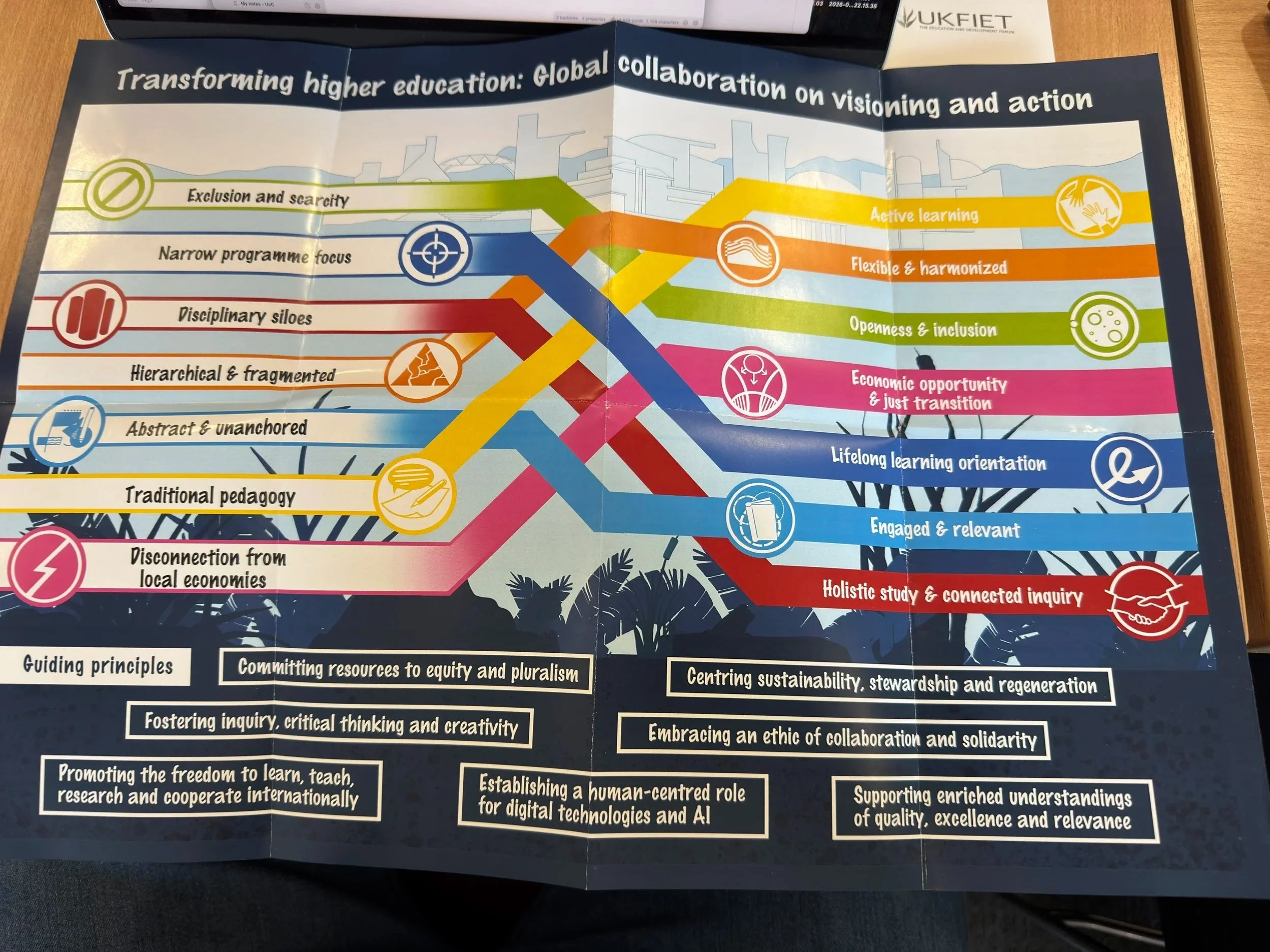
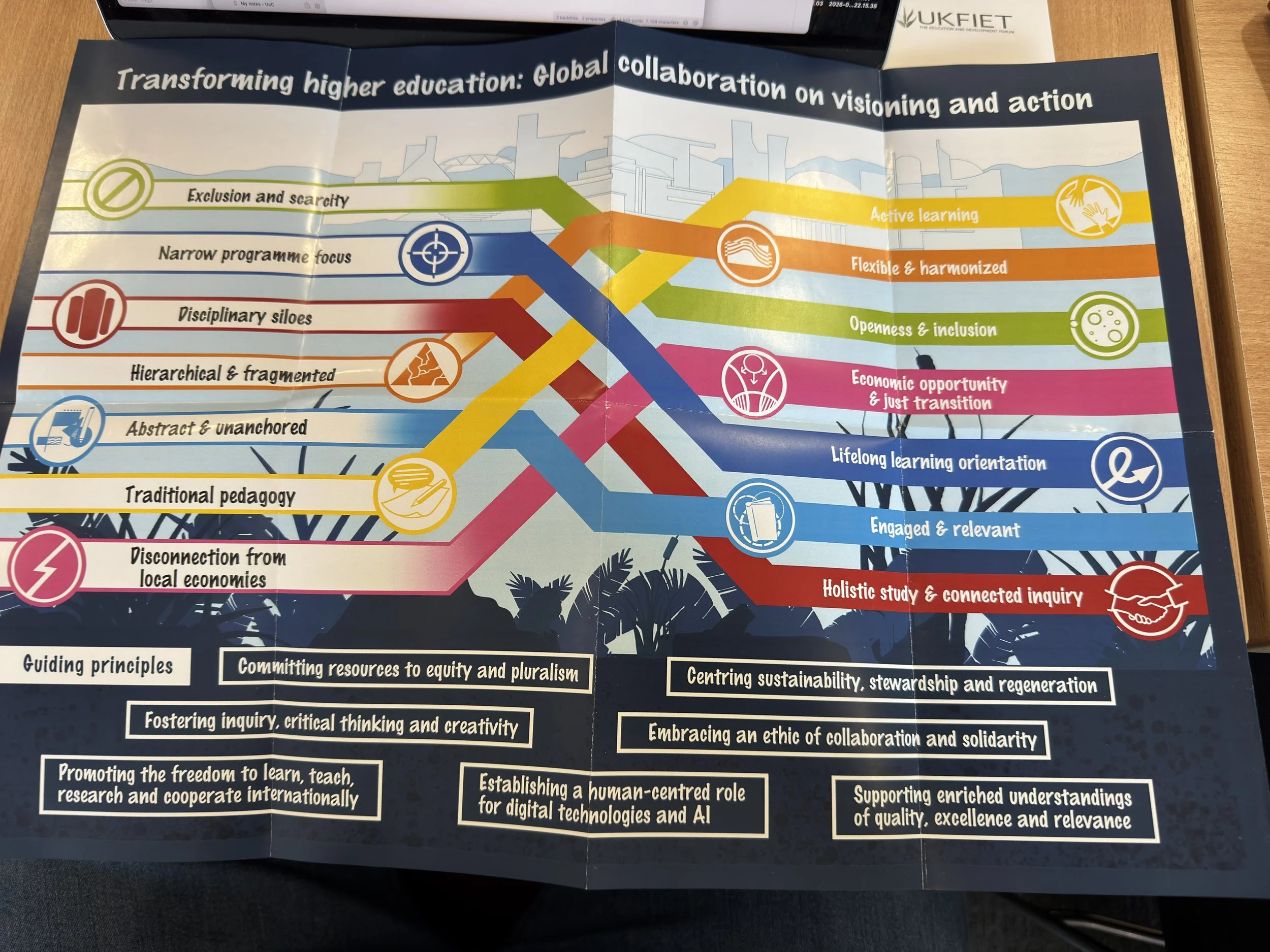
The visual from UNESCO (2026) uses a ribbon/flow diagram to map a transformation from current problems in higher education (left side) toward desired future states (right side):
Current challenges (left): exclusion and scarcity, narrow programme focus, disciplinary siloes, hierarchical and fragmented structures, abstract and unanchored learning, traditional pedagogy, and disconnection from local economies.
Transformed vision (right): active learning, flexible and harmonised systems, openness and inclusion, economic opportunity and just transition, lifelong learning orientation, engaged and relevant curricula, and holistic study and connected inquiry.
At the bottom, seven guiding principles anchor the framework: committing resources to equity and pluralism; fostering inquiry, critical thinking and creativity; promoting freedom to learn, teach, research and cooperate internationally; centring sustainability, stewardship and regeneration; embracing an ethic of collaboration and solidarity; establishing a human-centred role for digital technologies and AI; and supporting enriched understandings of quality, excellence and relevance.
Guiding principles to reshape the future of higher education (UNESCO, 2026)
The roadmap proposes seven guiding principles that are interlinked and mutually reinforcing:
Committing resources to equity and pluralism.
Promoting the freedom to learn, teach, research and cooperate internationally.
Fostering inquiry, critical thinking and creativity.
Establishing a human-centred role for digital technologies and artificial intelligence
Embracing an ethic of collaboration and solidarity.
Centring sustainability, stewardship and regeneration.
Supporting enriched understandings of quality, excellence and relevance.
The document and what it is asking of us
The UNESCO roadmap is the outcome of a remarkable consultative process: over 15,000 participants, more than 1,500 comments on a draft roadmap, and 250 knowledge products submitted from across the world. It sets out seven guiding principles and a set of lines of transformation intended to move higher education toward what it calls a new social contract. The principles call for committing resources to equity and pluralism; promoting the freedom to learn, teach, research, and cooperate internationally; fostering inquiry, critical thinking, and creativity; establishing a human-centered role for digital technologies and AI; embracing an ethic of collaboration and solidarity; centering sustainability, stewardship, and regeneration; and supporting enriched understandings of quality, excellence, and relevance (UNESCO, 2026).
What the session made clear is that many people working in higher education find these principles genuinely compelling. The hunger for a more collaborative, more inclusive, and more epistemically honest sector is real and broadly shared. What is less clear is whether institutions, as opposed to the individuals within them, are prepared to act on these principles when doing so would cost something: revenue, convenience, prestige, or the comfort of familiar ways of working.
Digital access as an equity question, not a technical one
The roadmap is explicit that enriching higher education with "the possibility to study online and/or in hybrid formats would open higher education to more diversified learner motivations and interests, as well as to those who pursue it alongside full-time employment or care work" (p. 41). It also recognizes that "students can learn in different settings and spaces, whether that be in workplaces, in communities, or different cultural settings" (p. 41).
These are not technical observations about learning management systems. They are equity arguments. And yet across the sector, a counter-movement is underway. Universities that expanded hybrid and online provision during the pandemic, often discovering in the process that engagement did not collapse and that participation from previously excluded groups increased, are now reverting to in-person-only defaults. The rationale is rarely made explicit. When it is, it tends to appeal to the value of campus community, the richness of in-person dialogue, or concerns about student isolation. These are not trivial considerations. But they are being invoked selectively, in ways that consistently favor the preferences of those for whom in-person attendance is easy over those for whom it is costly or impossible.
The roadmap's call to move from "a scarcity and exclusion mindset to an openness and inclusion paradigm" (p. 35) applies here directly. Decisions about session formats, whether a seminar, a meeting, a public lecture, or a research event is offered in hybrid form or in-person only, are not logistical defaults. They are choices about whose participation the institution is prepared to resource and whose it is prepared to make contingent on circumstances that are not equally distributed. For educators, this means thinking carefully about the assumptions embedded in format decisions that are often made without much thought at all. For policymakers, it means recognizing that guidance on hybrid provision, and the resourcing to support it properly, has not kept pace with the rhetoric of inclusion.
Collaborative assessment and the gap between what we teach and what we test
The roadmap calls for pedagogical approaches to move away from "traditional listen-and-repeat methods" and toward active, problem-based, and project-based learning. It argues that "significant learning experiences often begin with a genuinely felt problem motivating the learner" and that student-centeredness means "involving learners in their own learning, so they are the ones making connections and shaping meaning" (p. 45). The document describes the overarching aim of higher education as building "collective and individual capacities for facing our common challenges together" (p. 29).
The conversations in our session pointed to strong agreement with this direction. And yet the dominant model of assessment in higher education remains resolutely individual. Students may be invited to collaborate in seminars, workshops, and project groups. But when grades are assigned, it is nearly always the individual who is evaluated. The group is, in practice, a scaffold for solo performance.
This is not a minor inconsistency. It sends a clear signal to students about what the institution actually values, regardless of what it says about collaboration, communication, and citizenship. If we believe, as the roadmap argues, that higher education's purpose is to build people who can face shared challenges together, then assessing them only as isolated individuals is a structural contradiction at the heart of the enterprise.
The objection that collaborative assessment is difficult to do fairly is real but insufficient. These are design problems, and they are solvable. What they require is institutional will: the willingness to invest in assessment literacy among staff, to create conditions for genuine pedagogical experimentation, and to accept that the discomfort of change is not a reason to preserve a model that is increasingly misaligned with the capabilities higher education claims to develop. For researchers, this is an area where practice-based educational research can make a direct contribution. For policymakers, it is an area where quality frameworks and professional standards could do more to reward innovation in assessment design rather than defaulting to the legibility of individual grades.
Decolonization and the question of whose knowledge counts
Perhaps the most resonant theme of the session was the need to take seriously the decolonization of knowledge: not as a metaphor, a branding exercise, or a curriculum add-on, but as a fundamental rethinking of whose ways of knowing are recognized, valued, and built upon in higher education.
The roadmap is direct about this. It acknowledges that "the claims of local and indigenous knowledge systems are increasingly prevalent, with voices from the global south dismantling knowledge gatekeeping" (p. 17), and calls for universities to engage with "plural forms of knowing as these are practiced by various communities around the globe" (p. 23). In its sixth guiding principle, it calls for research and scholarship to be "democratized, decolonized and disseminated to serve the common good" (p. 31). It argues that universities must go beyond respect and tolerance to ensure that "heterogenous ways of knowing and being become a welcome and respected foundation for building futures together" (p. 23).
For educators, this demands more than adding readings from the Global South to an otherwise unchanged curriculum. It requires examining the epistemic assumptions embedded in how disciplines are structured, what counts as rigorous methodology, which citations carry authority, and whose theoretical frameworks are treated as universal while others are marked as regional or merely applied. These are uncomfortable questions for many established academics, precisely because they put the foundations of expertise under scrutiny rather than merely its contents.
For policymakers, the decolonization agenda has implications for hiring practices, research funding priorities, quality assurance frameworks, and the governance structures of universities themselves. Institutions that talk about decolonization without addressing who sits on their hiring panels, whose research agendas attract institutional investment, and how their quality metrics are constructed are engaging in a form of performativity that the roadmap is trying to move us beyond.
Crucially, as I argue in the companion piece, epistemic justice and material justice are not separable. The question of whose knowledge is centered in a curriculum cannot be fully addressed while the question of who can afford to show up to engage with it remains unresolved. Universities are simultaneously asking people to think more expansively about knowledge while making the conditions of intellectual participation materially harder for precisely the communities whose perspectives the curriculum most needs.
A note on institutional culture and the cost of belonging
There is a question worth putting to any institution that claims to take equity seriously: what does it cost someone to spend a day on your campus? Not in tuition or fees, but in the accumulated small expenditures, transport, food, a hot drink, that constitute the texture of belonging. The answer varies considerably across institutions and across the sector, and the variation is not random. It tends to reflect how seriously an institution has thought about whose comfort and whose finances it has designed itself around.
For policymakers and institutional leaders, this is worth attending to. The grand language of transformation in documents like the UNESCO roadmap finds its test not only in curriculum reform or strategic plans but in the daily, material conditions of the people the institution is supposed to serve. I take this up in much more concrete terms in the companion piece, which looks specifically at Glasgow.
Calls to action
For educators: examine the assumptions embedded in your default practices. When you schedule an in-person-only session, ask who that decision excludes and whether the exclusion is pedagogically justified. When you design an assessment, ask whether it tests the capabilities you claim to value or merely the ones that are easiest to grade individually. When you design or teach a course, ask whose knowledge its theoretical foundations are built on and whether that foundation is as universal as it has been presented.
For researchers: the gap between the transformative agenda the UNESCO roadmap describes and the practices of actual institutions is a rich and urgent site for educational research. Work that documents the equity impacts of hybrid provision decisions, evaluates collaborative assessment models, and traces the relationship between material precarity and epistemic participation is directly actionable. It does not need to wait for the sector to catch up. It can help create the conditions for it to do so.
For policymakers: the seven principles in the UNESCO roadmap are only as meaningful as the frameworks, funding mechanisms, and accountability structures that support them. Guidance on hybrid provision, investment in integrated transport where universities are anchor institutions, reform of quality frameworks to reward pedagogical innovation, and serious attention to student financial support are not peripheral concerns. They are the infrastructure on which the new social contract the roadmap calls for either stands or falls.
The roadmap closes with the observation that "transforming higher education will always be an iterative, ongoing, multilateral and intergenerational process" (p. 55). That is true. It is also, if we are not careful, a way of making peace with the distance between vision and practice. The question is not whether transformation is possible. It is whether we are prepared to begin it, seriously, now.
A companion piece, focusing on what these arguments look like in the specific context of Glasgow, its housing emergency, its fragmented transport system, and the daily material conditions of the students and staff who make up its universities, follows shortly.
References & further information
UNESCO. (2026). Transforming higher education: Global collaboration on visioning and action.
Launch event for the roadmap
A snapshot of what the document is about

Listening, Speaking, Learning: On Verbal Feedback and (Re)Humanizing Assessment

Sunset over Queens Park pond, Glasgow, UK
Recently, I listened to a podcast from 2022, Educatalks: Reflective Practice featuring Professor Melaine Coward, a professor of medical education reflect on her career and her commitment to reflective practice. Medical Educatalks is a podcast created by the Developing Medical Educators Group (DMEG) at the Academy of Medical Educators. Toward the end of the conversation, she described her decision to give students verbal feedback on their assessments. The interviewer sounded genuinely surprised, he hadn’t encountered that approach before.
I paused.
Not because it felt novel, but because it felt familiar.
In 2015, while teaching at a University of London institution, I experimented with providing verbal feedback on written assignments. At the time, our digital marking platform enabled tutors to attach audio recordings directly to students’ scripts, so feedback could be posted alongside the written work itself. Students could either listen asynchronously or book a short follow-up slot to discuss it further. I would have their script in front of me as I recorded or spoke with them, talking through strengths, misunderstandings, and next steps. It was dialogic, immediate, and relational, but it was not universally welcomed.
The pushback was swift and couched in procedural language:
How could this be standardized?
How could it be moderated?
Where was the audit trail?
Ironically, the digital system did generate an artefact. The audio file was stored alongside the script. There was a record. And yet the discomfort persisted. What seemed to trouble colleagues was not the absence of documentation, but the presence of voice, with its tone, inflection, and spontaneity. Feedback had become less easily reduced to a static text block. The underlying concern was not simply technical. It was cultural. Feedback, in this framing, was not primarily a pedagogical encounter, it was a compliance mechanism.
Listening to Coward years later, I realized something I could not fully articulate back then: verbal feedback is not merely a technique. It is an epistemological stance. It is a small but meaningful act of (re)humanising assessment.
“But what I found was, so they weren’t reading the comments that I’d spent ages putting on marking there, because I do spend time, it matters that I give good feedback. When I did recorded feedback, I found I had a lot more follow-up from students, because they had had to listen to my feedback, and it was a very clear message of, I really enjoyed this, something for you to think about. I would be quite structured in how I recorded it, so I had notes, so it was formulaic in that sense, but not rehearsed.”
Feedback as encounter, not transmission
Higher education assessment cultures are deeply shaped by what Paulo Freire famously critiqued as the “banking model” of education in Pedagogy of the Oppressed. In that model, knowledge is deposited; feedback becomes a written correction of deficits; learning is framed as remediation.
Written feedback, of course, can be thoughtful and transformative. But it often operates within systems that prioritize defensibility over dialogue. Comments are calibrated for external examiners. Language becomes cautious. Tone becomes formal and neutralized. The student becomes a case.
Audio feedback, even when delivered asynchronously through a digital platform, subtly shifts that dynamic. Students hear emphasis. They hear encouragement. They hear uncertainty where appropriate. Meaning is shaped not only by what is said, but how it is said.
And when audio is paired with optional follow-up conversation, feedback becomes dialogic in a deeper sense. Students can respond, query, reinterpret.
This resonates with Freire’s insistence on dialogue as the foundation of emancipatory education. It also aligns with bell hooks’ vision of engaged pedagogy in Teaching to Transgress, where teaching and learning are relational acts rather than one-way transmissions.
When we speak with students rather than at them, feedback becomes less about surveillance and more about growth. Voice, literal voice, reintroduces presence into assessment by (re)humanizing it.
The standardization question
The resistance I encountered in 2015 revolved around standardisation. Written comments were seen as stable, recordable, and therefore fair. Audio feedback, even though stored and retrievable, was viewed as potentially variable.
But here is the uncomfortable truth: standardization is not synonymous with justice.
Critical and decolonial scholars have long questioned whose norms assessment criteria encode. Ngũgĩ wa Thiong'o, in Decolonising the Mind, reminds us that language and evaluation are never neutral; they are embedded within colonial power structures. Similarly, scholars of antiracist pedagogy argue that assessment practices often privilege dominant linguistic and epistemic norms and performances.
Audio feedback can surface some of this hidden curriculum. It allows educators to unpack what we mean by “criticality” or “coherence” in accessible, responsive ways. It can soften deficit framings by conveying nuance and care. It can make tacit expectations explicit.
For neurodivergent students, multilingual students, or those unfamiliar with disciplinary conventions, hearing feedback, with tone and pacing, can support comprehension in ways that dense written comments may not.
Uniform delivery formats may be easier to audit. But equity sometimes requires responsiveness.
Reflective practice and professional identity
Coward’s framing of verbal feedback emerged from reflective practice, a concept often associated with Donald Schön and his work The Reflective Practitioner. Reflection is not merely about improving technique; it is about interrogating the assumptions that underpin our actions.
Looking back, I can see that my 2015 experience exposed a tension between two logics and a clash of paradigms:
Assessment as pedagogical relationship / Was feedback a compliance mechanism or a pedagogical relationship?
Assessment as quality assurance infrastructure / Was my role to produce defensible documentation or to cultivate understanding?
The digital tool itself was neutral. It could host text or voice. The debate was about what counted as legitimate academic labor and legitimate evidence of fairness.
Reflective practice asks us to interrogate not only how we teach, but why certain practices are normalized while others are treated as suspect.
(Re)humanizing assessment in digital spaces
In my current work, including conversations around decolonizing curricula and rethinking assessment, I often return to a simple question:
What would assessment look like if we centered humanity rather than auditability?
This is not an argument to abandon rigor or documentation. Rather, it is a call to re-balance priorities.
(Re)humanizing assessment might include:
Dialogic feedback conversations alongside written summaries
Audio or video feedback that conveys tone and relational presence
Opportunities for students to respond to feedback
Co-constructed criteria discussions
Assessment designs that value multiple ways of knowing
These moves resonate with broader critical pedagogical commitments: resisting neoliberal metrics, challenging deficit framings, and recognizing students as co-participants in knowledge production. These moves further resonate with critical pedagogy’s insistence on dialogue, with antiracist commitments to challenging hidden norms, and with decolonial calls to unsettle inherited hierarchies of knowledge.
They also align with emerging scholarship on compassionate pedagogy and relational assessment cultures within higher education.
“Hearing someone talk about what you’ve done, the tone and voice to highlight praise, concern, and you can add in a more questioning tone ... They loved it. They loved it because they could hear from my touch. ”
An epiphany, years later: are our systems human enough?
Listening to Coward describe her practice, I felt both affirmed and reflective. The surprise expressed by the podcast interviewer revealed how deeply entrenched written, standardized feedback remains. Yet the fact that such practices continue to surface across disciplines, from medical education to the humanities, suggests a quiet shift. I also felt less concerned with whether verbal feedback is innovative and more interested in what it reveals. What I once framed defensively as “innovative feedback” now feels more clearly like a small act of resistance against depersonalized academic systems.
Even when captured and archived in a digital platform, voice unsettles the fantasy that assessment can be entirely standardised and neutral. It reintroduces tone, care, and relational accountability.
Perhaps the question is not whether audio feedback can be moderated.
Perhaps the more urgent question is whether our assessment cultures allow space for humanity, for dialogue, for nuance, for recognition.
If critical, antiracist, and decolonial pedagogies ask us to re-centre people rather than processes, then even something as simple as attaching a recorded voice note to a script can become a quietly radical act.
Suggested further reading
Pedagogy of the Oppressed – Paulo Freire
Teaching to Transgress – bell hooks
Decolonising the Mind – Ngũgĩ wa Thiong'o
A Handbook of Reflective and Experiential Learning – Jennifer A. Moon
The Reflective Practitioner – Donald Schön
And, of course, I would recommend listening to Educatalks: Reflective Practice featuring Melaine Coward, not because verbal feedback is revolutionary, but because reflective conversations about practice remind us that teaching is, at its heart, relational work.
In a sector increasingly governed by metrics, that reminder feels quietly radical.

Exploring ideas for decolonizing the curriculum using generative AI tools
In this post, I share some examples created by generative AI for decolonizing the curriculum. I also contextualize the examples by providing commentary from colleagues from the University of Glasgow Decolonising the Curriculum Community of Practice.
“The master’s tools will never dismantle the master’s house.”
In this post, I share some examples created by generative AI for decolonizing the curriculum. I also contextualize the examples by providing commentary from colleagues from the University of Glasgow Decolonising the Curriculum Community of Practice.
Decolonizing education is part of many university strategies, including the university where I work. So, it seemed natural to think of how generative AI tools might help university students and staff think of ideas for decolonizing the curriculum. However, we must remember that the underlying logic of generative AI represents tools created by those in nations that hold power over others. Generative AI tools are often created in former imperial nations that seek out and obtain cheaper labor in other parts of the world to train and ‘develop’ the tools further. Generative AI also imparts a significant environmental impact, which must be considered.
AI and ethical considerations: coloniality of…
There are several caveats to using AI and generative AI generally, which I briefly outline in Karen Hao’s article from July 2020:
ghost work
this is invisible labor provided by underpaid workers who are often in former US and UK colonies (among others)
beta testing
sometimes beta testing is used on more vulnerable groups; yes, this is unethical, but it does still happen
AI governance
think about who creates governance for AI; high-wealth nations and the Global North largely drive this at the expense of Global South nations
international social development
if we consider ‘AI for…’ initiatives, we have to consider who drives these and who the targets or recipients are
algorithmic discrimination and oppression
if we consider who creates algorithms, then we can begin to understand why some algorithms can portray racist, gendered, xenophobic imagery
Further reading
To understand the ethical issues of generative AI by using a decolonial lens, have a read of these:
Hao, K. (2020). The problems AI has today go back centuries. MIT Technology Review. https://www.technologyreview.com/2020/07/31/1005824/decolonial-ai-for-everyone/
Hosseini, D. (2023). Generative AI: a problematic illustration of the intersections of racialized gender, race, ethnicity. https://www.dustinhosseini.com/blog/2023/08/08/generative-ai-a-problematic-illustration-of-the-intersections-of-racialized-gender-race-ethnicity
Mohamed, S., Png, M. T., & Isaac, W. (2020). Decolonial AI: Decolonial theory as sociotechnical foresight in artificial intelligence. Philosophy & Technology, 33, 659-684. https://link.springer.com/article/10.1007/s13347-020-00405-8
Zembylas, M. (2023). A decolonial approach to AI in higher education teaching and learning: Strategies for undoing the ethics of digital neocolonialism. Learning, Media and Technology, 48(1), 25-37. https://www.tandfonline.com/doi/full/10.1080/17439884.2021.2010094?casa_token=qQjMpifVSaAAAAAA%3AZlWVF-kVnHnzHnF7B9zTow4mZUftx7rwKvnWYNkjAeHYu8BX2hxYXAMtE-F0HNO5WCctYblypLVU
Generative AI’s suggestions for decolonizing
For the following outputs, as shown in the GIF images below, I used the initial prompt:
I'm a lecturer and there is talk of decolonising the curriculum. I teach mathematics and statistics. What can I do to start decolonising my curriculum?
As we can see in the GIFs below, each generative AI tool appears to give some considered suggestions for how a lecturer in this particular area might go about decolonizing the curriculum they teach. Ideas such as incorporating more diverse views, Indigenous knowledges and contextualizing what is being learned are all general suggestions that I might expect to find in such a curriculum that is undertaking decolonizing.
However, I wanted to see more detail and so I followed up with another prompt.


The follow-up prompt was designed to see what else generative AI might suggest. Interestingly, with insight from colleagues, plenty could be done and suggested to create a curriculum that undertakes decolonization within a specific context.
In this case, the lists seemed familiar and similar in some respects and then a bit different in other respects in ways that I couldn’t immediately pick up on. The suggested names stem from ancient to modern times, albeit with a jump between ancient and modern times! Some familiar names are there, but are there perhaps some that could be included?
Here is the prompt I used:
What are some prominent but overlooked non-Western scholars of mathematics and statistics?


Reflections from colleagues
I consulted some colleagues, given the topic, the example is from an area I’m not familiar with. Specifically, I consulted colleagues in the UofG Decolonising the Curriculum Community of Practice who kindly provided their thoughts.
Soryia Siddique, whose background is in chemistry/pharmaceuticals/politics, provided the following:
My initial observation is that we ensure women of colour are represented in the materials. Perhaps a specific search around this.
BAME and Muslim women are underrepresented in many professions, including senior roles in Scotland, and are likely to experience systemic bias. Taking into consideration that Muslim women can experience racisim, sexism, and Islamaphobia. It is questionable whether media/society represents Muslim and BAME women's current and historical achievements.
They are also "missing” from Scotland’s media landscape.
In utilising AI, are we relying on data that is embedded in algorithmic bias and potentially perpetuating further inequality?
Soryia also suggested the following reading: The Movement to Decolonize AI: Centering Dignity Over Dependency from Standford University’s Human-Centered Artificial Intelligence. It’s an interview with Sabelo Mhlambi who describes the role of AI in colonization and how activists can counter this.
Samuel Skipsey, whose background is in physics and astronomy, also shared his thoughts:
The "list of important non-Westerners" is fairly comparable between the two - Bard is more biased towards historical examples and is pretty India-centric (with no Chinese or Japanese examples, notably), ChatGPT does a lot better at covering a wider baseline of "top hits" across the world (although given that "Nine Chapters on the Mathematical Art" doesn't have known authors - the tradition of the time it was written means that it probably had many contributions whose authorship is lost to history - I would quibble about it being a "scholar"). I note that this is still a Northern-Hemisphere centric list from both - although that's somewhat expected due to the problems citing material from pre-colonial Latin America, say. Still, it would have been nice to see some citation of contributions from Egypt, say.
In general, both lists are subsets of the list I would have produced by doing some Wikipedia diving.
The "advice on decolonising" is very high-level and tick-boxy from both. It feels like they're sourced from a web search (and, indeed, on an experimental search on DDG [DuckDuckGo] for "how can I decolonise my course" the first few hits all have a set of bullet points similar to those produced by the LLMs, which is unsurprising). To be fair to the LLMs, this is also basically what a lot of "how do I start decolonising" materials look like when produced by humans, so...
As Soryia notes, because the answers are quite generic there's a bunch of specific considerations that they don't touch on (they're not very intersectional - Hypatia turns up on both lists of non-Western scholars, doing a lot of heavy lifting as the only female name on either!)