Critical AI Engagement Framework
NB: This page was original published 24 March 2026, and has since been updated on 21 May 2026 to reflect the latest framework iteration (Version 1.4). A further update was made on 26 August to add the interactive version of the framework, available on a separate page.
This framework draws on Hosseini's (2026) forthcoming paper in The Geographical Journal, which examines how generative AI tools reproduce racial, gendered, and class-based representations through algorithmic coloniality (Mohamed et al., 2020). That work demonstrates how seemingly neutral prompts encode dominant cultural assumptions, producing outputs that reflect and reinforce existing inequalities.
The Critical AI Engagement Framework extends this analysis into a practical pedagogical tool, mapping how individuals engage with generative AI across two axes: epistemic posture and structural consciousness. It is designed for use across educational contexts, supporting educators and learners in moving beyond prompt refinement toward critical, collective, and structurally informed engagement with AI systems.
April 2026 update: the paper informing this framework has now been published and is available below.
May 2026 update: version 1.4 of the framework is towards the end of this page.
August 2026 update: you can find an interactive and mobile-friendly version fo the Critical AI Framework at the following page.
Hosseini, D. D. 2026. “Generative AI: A Problematic Illustration of the Intersections of Race, Gender and Class.” The Geographical Journal 192, no. 2: e70085. https://doi.org/10.1111/geoj.70085.
Generative AI tools are now embedded in higher education, used to draft text, generate images, produce code, and synthesise research. Yet these tools are not neutral. They encode the assumptions, hierarchies, and exclusions of the data they were trained on, reproducing patterns of racial, gendered, and class-based harm even as their outputs become more sophisticated (Benjamin, 2019; Mohamed et al., 2020; Noble, 2018). Understanding how students engage with these tools, and what that engagement does or does not interrogate, is therefore an urgent task for educators.
The Critical AI Engagement Framework maps educational engagement with generative AI across two axes. The horizontal axis describes an individual’s epistemic posture toward AI: from treating its outputs as authoritative, through questioning them, to recognising the colonial and structural conditions that shape what AI knows, whose knowledge it centres, and what it silences (Hosseini, 2026; Maalsen, 2023). The vertical axis describes how far an individual recognises AI as a socio-technical artefact shaped by relations of power, rather than simply a tool with fixable flaws (Benjamin, 2019; Quijano, 2000; Zembylas, 2023). The positions individuals occupy are not freely chosen but reflect the institutional, curricular, and social conditions that shape how they learn and work. The framework’s aspiration is not a more capable individual user but collective action: sustained, community-grounded engagement that works toward structural change (Camacho Felix, 2025; Mohamed et al., 2020).
neutral & apolitical
lacks systemic account
coloniality & harm
Critical AI Engagement Framework Version 1.4
This version adds in the researcher lens and concepts such as epistemic accountability and the research lifecycle.
Generative AI tools are now embedded in higher education, used to draft text, generate images, produce code, and synthesise research. Yet these tools are not neutral. They encode the assumptions, hierarchies, and exclusions of the data they were trained on, reproducing patterns of racial, gendered, and class-based harm even as their outputs become more sophisticated (Benjamin, 2019; Mohamed et al., 2020; Noble, 2018). Understanding how students engage with these tools, and what that engagement does or does not interrogate, is therefore an urgent task for educators.
The Critical AI Engagement Framework maps educational engagement with generative AI across two axes. The horizontal axis describes an individual’s epistemic posture toward AI: from treating its outputs as authoritative, through questioning them, to recognizing the colonial and structural conditions that shape what AI knows, whose knowledge it centers, and what it silences (Hosseini, 2026; Maalsen, 2023). The vertical axis describes how far an individual recognizes AI as a socio-technical artefact shaped by relations of power, rather than simply a tool with fixable flaws (Benjamin, 2019; Quijano, 2000; Zembylas, 2023). The positions individuals occupy are not freely chosen but reflect the institutional, curricular, and social conditions that shape how they learn and work. The framework’s aspiration is not a more capable individual user but collective action: sustained, community-grounded engagement that works toward structural change (Camacho Felix, 2025; Mohamed et al., 2020).
neutral & apolitical
lacks systemic account
coloniality & harm
This view reframes the framework for researchers engaging with generative AI across the research process. The two applied sections in each cell address the researcher's own practice and the dimension of epistemic accountability — a concept that holds together citational justice (the obligation to credit ideas and intellectual labour whether or not they appear in a formal reference list) and research integrity (the obligation to be transparent about the conditions, limitations, and role of AI in knowledge production). Together they ask: is this knowledge claim accountable — to its sources, its methods, and the communities it draws on?
Positions are not fixed. A researcher may occupy different cells across different phases of the research lifecycle, and across different relationships — with their own field, with collaborators, with communities whose knowledge they draw on.
neutral & apolitical
lacks systemic account
coloniality & harm
This view adds epistemic accountability as a fourth dimension alongside the original three sections. Epistemic accountability holds together two obligations that AI use makes newly urgent: citational justice — recognising whose ideas are absorbed through AI-mediated synthesis and naming intellectual contributions that fall outside formal citation conventions — and research integrity — being transparent about the conditions, limitations, and role of AI in knowledge production. Neither subordinates the other. Citational justice asks whose labour is acknowledged; research integrity asks whether the conditions of production are honestly disclosed. Together they ask: is this knowledge claim accountable — to its sources, its methods, and the communities it draws on?
This view preserves the educational framing (theoretical anchor, for educators, for students) and adds epistemic accountability as a cross-cutting dimension that applies regardless of whether the user is a researcher, educator, or student. AI use in educational contexts raises the same questions of intellectual credit, attribution transparency, and relational accountability as it does in formal research.
neutral & apolitical
lacks systemic account
coloniality & harm
This view maps AI engagement across the research lifecycle, tracing how epistemic posture — from deference to collective agency — manifests differently at each phase of research practice. Each phase carries distinct risks and possibilities: the literature and framing phase is where AI most aggressively shapes what counts as relevant scholarship; methodology and design is where colonial defaults in AI recommendations become embedded in the research architecture; data and evidence is where AI's training hierarchies most directly affect what gets surfaced and what gets buried; analysis and interpretation is where AI can flatten the conceptual moves that distinguish critical from descriptive work; writing and synthesis is where citational erasure is most invisible; and publication and dissemination is where structural change is most possible — and most resisted.
The epistemic accountability dimension (gold) runs through all phases but intensifies toward dissemination. It addresses two obligations simultaneously: citational justice — whose intellectual labour is acknowledged, including named authors, unnamed collaborators, community knowledge, conversations, and ideas that circulate before they are published — and research integrity — transparent disclosure of how AI was used, what it could not see, and what structural conditions shaped the knowledge produced. Both are present at every phase; the balance between them shifts as the research progresses.
The phase where AI most aggressively determines whose scholarship counts as foundational. Epistemic deference here shapes the entire conceptual architecture of the research.
AI methodology recommendations embed epistemological defaults — which methods count as rigorous, whose frameworks are treated as standard — that shape what the research can find before data collection begins.
AI's training hierarchies directly affect what gets surfaced and what gets buried. At this phase, algorithmic coloniality is most materially consequential — shaping whose experiences, voices, and data are treated as valid evidence.
AI analysis flattens complexity and forecloses interpretive possibilities. The conceptual moves that distinguish critical from descriptive research are most at risk here — as AI tends toward synthesis, consensus, and the resolution of tension.
Citational erasure is most invisible at this phase. AI-assisted writing absorbs ideas, framings, and formulations without tracing them to their origins — and researchers may not notice because the output reads as their own.
The phase where structural change is most possible and most resisted. Publishing choices — venue, format, access, co-authorship conventions — are themselves political acts that reproduce or challenge the knowledge hierarchies AI encodes.

Exploring ideas for decolonizing the curriculum using generative AI tools
In this post, I share some examples created by generative AI for decolonizing the curriculum. I also contextualize the examples by providing commentary from colleagues from the University of Glasgow Decolonising the Curriculum Community of Practice.
“The master’s tools will never dismantle the master’s house.”
In this post, I share some examples created by generative AI for decolonizing the curriculum. I also contextualize the examples by providing commentary from colleagues from the University of Glasgow Decolonising the Curriculum Community of Practice.
Decolonizing education is part of many university strategies, including the university where I work. So, it seemed natural to think of how generative AI tools might help university students and staff think of ideas for decolonizing the curriculum. However, we must remember that the underlying logic of generative AI represents tools created by those in nations that hold power over others. Generative AI tools are often created in former imperial nations that seek out and obtain cheaper labor in other parts of the world to train and ‘develop’ the tools further. Generative AI also imparts a significant environmental impact, which must be considered.
AI and ethical considerations: coloniality of…
There are several caveats to using AI and generative AI generally, which I briefly outline in Karen Hao’s article from July 2020:
ghost work
this is invisible labor provided by underpaid workers who are often in former US and UK colonies (among others)
beta testing
sometimes beta testing is used on more vulnerable groups; yes, this is unethical, but it does still happen
AI governance
think about who creates governance for AI; high-wealth nations and the Global North largely drive this at the expense of Global South nations
international social development
if we consider ‘AI for…’ initiatives, we have to consider who drives these and who the targets or recipients are
algorithmic discrimination and oppression
if we consider who creates algorithms, then we can begin to understand why some algorithms can portray racist, gendered, xenophobic imagery
Further reading
To understand the ethical issues of generative AI by using a decolonial lens, have a read of these:
Hao, K. (2020). The problems AI has today go back centuries. MIT Technology Review. https://www.technologyreview.com/2020/07/31/1005824/decolonial-ai-for-everyone/
Hosseini, D. (2023). Generative AI: a problematic illustration of the intersections of racialized gender, race, ethnicity. https://www.dustinhosseini.com/blog/2023/08/08/generative-ai-a-problematic-illustration-of-the-intersections-of-racialized-gender-race-ethnicity
Mohamed, S., Png, M. T., & Isaac, W. (2020). Decolonial AI: Decolonial theory as sociotechnical foresight in artificial intelligence. Philosophy & Technology, 33, 659-684. https://link.springer.com/article/10.1007/s13347-020-00405-8
Zembylas, M. (2023). A decolonial approach to AI in higher education teaching and learning: Strategies for undoing the ethics of digital neocolonialism. Learning, Media and Technology, 48(1), 25-37. https://www.tandfonline.com/doi/full/10.1080/17439884.2021.2010094?casa_token=qQjMpifVSaAAAAAA%3AZlWVF-kVnHnzHnF7B9zTow4mZUftx7rwKvnWYNkjAeHYu8BX2hxYXAMtE-F0HNO5WCctYblypLVU
Generative AI’s suggestions for decolonizing
For the following outputs, as shown in the GIF images below, I used the initial prompt:
I'm a lecturer and there is talk of decolonising the curriculum. I teach mathematics and statistics. What can I do to start decolonising my curriculum?
As we can see in the GIFs below, each generative AI tool appears to give some considered suggestions for how a lecturer in this particular area might go about decolonizing the curriculum they teach. Ideas such as incorporating more diverse views, Indigenous knowledges and contextualizing what is being learned are all general suggestions that I might expect to find in such a curriculum that is undertaking decolonizing.
However, I wanted to see more detail and so I followed up with another prompt.


The follow-up prompt was designed to see what else generative AI might suggest. Interestingly, with insight from colleagues, plenty could be done and suggested to create a curriculum that undertakes decolonization within a specific context.
In this case, the lists seemed familiar and similar in some respects and then a bit different in other respects in ways that I couldn’t immediately pick up on. The suggested names stem from ancient to modern times, albeit with a jump between ancient and modern times! Some familiar names are there, but are there perhaps some that could be included?
Here is the prompt I used:
What are some prominent but overlooked non-Western scholars of mathematics and statistics?


Reflections from colleagues
I consulted some colleagues, given the topic, the example is from an area I’m not familiar with. Specifically, I consulted colleagues in the UofG Decolonising the Curriculum Community of Practice who kindly provided their thoughts.
Soryia Siddique, whose background is in chemistry/pharmaceuticals/politics, provided the following:
My initial observation is that we ensure women of colour are represented in the materials. Perhaps a specific search around this.
BAME and Muslim women are underrepresented in many professions, including senior roles in Scotland, and are likely to experience systemic bias. Taking into consideration that Muslim women can experience racisim, sexism, and Islamaphobia. It is questionable whether media/society represents Muslim and BAME women's current and historical achievements.
They are also "missing” from Scotland’s media landscape.
In utilising AI, are we relying on data that is embedded in algorithmic bias and potentially perpetuating further inequality?
Soryia also suggested the following reading: The Movement to Decolonize AI: Centering Dignity Over Dependency from Standford University’s Human-Centered Artificial Intelligence. It’s an interview with Sabelo Mhlambi who describes the role of AI in colonization and how activists can counter this.
Samuel Skipsey, whose background is in physics and astronomy, also shared his thoughts:
The "list of important non-Westerners" is fairly comparable between the two - Bard is more biased towards historical examples and is pretty India-centric (with no Chinese or Japanese examples, notably), ChatGPT does a lot better at covering a wider baseline of "top hits" across the world (although given that "Nine Chapters on the Mathematical Art" doesn't have known authors - the tradition of the time it was written means that it probably had many contributions whose authorship is lost to history - I would quibble about it being a "scholar"). I note that this is still a Northern-Hemisphere centric list from both - although that's somewhat expected due to the problems citing material from pre-colonial Latin America, say. Still, it would have been nice to see some citation of contributions from Egypt, say.
In general, both lists are subsets of the list I would have produced by doing some Wikipedia diving.
The "advice on decolonising" is very high-level and tick-boxy from both. It feels like they're sourced from a web search (and, indeed, on an experimental search on DDG [DuckDuckGo] for "how can I decolonise my course" the first few hits all have a set of bullet points similar to those produced by the LLMs, which is unsurprising). To be fair to the LLMs, this is also basically what a lot of "how do I start decolonising" materials look like when produced by humans, so...
As Soryia notes, because the answers are quite generic there's a bunch of specific considerations that they don't touch on (they're not very intersectional - Hypatia turns up on both lists of non-Western scholars, doing a lot of heavy lifting as the only female name on either!)

Experimenting with generative AI: (re)designing courses and rubrics
In this post, I share some ideas for (re)creating courses and assessment rubrics as well as getting ideas for creative assessments using generative AI.
Experimenting for creating a course
I tried out Google Bard and chatGPT 3.5 to design courses and rubrics. In each case, being specific about what I wanted to see created was key. What this means is that when you are creating your prompt or query, you should be specific in terms of:
Context: e.g. state who you are or who you imagine yourself to be when creating the prompt
Audience: who is the audience of what you want to create? Students? Staff? Administrators? Management? The Public?
Purpose: in brief terms, what do you want to achieve?
Scope: similar to context, however, I see this as more focused, so ‘create a university level course on sociology’ is fine, but narrowing it down to ‘Year 1, Year 2’ etc. will focus the prompt and subsequently generate examples more tightly.
Length: it’s always helpful to state the length of the proposed course or output. For example, are you asking for a draft of a 12-week course? A two-page maximum syllabus? A three-paragraph summary?
For this example, I used the following prompt…
I am a lecturer who teaches university-level chemistry. I wish to create a new course on inorganic chemistry for Year 2 university students. The course should be 12 weeks long and have 4 assignments. What might this look like?
Below are two GIFs showing chatGPT and Google Bard respectively.
NB: You may wish to select the images to see a larger version.


Brief reflections
I used a similar prompt for both generative AI tools. I decided to add an element of creativity when so I slightly changed the prompt when using Google Bard to get it to suggest creative assessments. I then went back to chatGPT to ask it do also suggest ideas for creative assessments within the context of this course.
They seem to produce similar results regarding this particular prompt. Both suggest an outline of a suggested course on inorganic chemistry; while Google Bard integrates the creative assessments into some of the topics, chatGPT predictably creates a list of suggested creative assessments as I had asked it after the initial prompt.
Interestingly, Google Bard also expands a bit at the end of the outline with further examples of non-written, creative assessments. chatGPT, on the other hand, does give some examples of ways of supporting learning and teaching after creating an example course outline. The creative assessments it lists are similar to those of Google Bard, although they are different, such as the quiz show example among others.
For transparency, I do not teach chemistry nor have I taught it. I have, however, supported those learning chemistry with their academic writing abilities, including writing lab reports and researching the topic. On the surface, the course looks coherent. However, I will leave that to those who teach chemistry!
What you can do
To replicate what I’ve done, copy and paste the prompt into your generative AI tool of choice.
Please note: you’ll likely get a slightly different response. I did not test each response again. That said, Google Bard automatically offers additional draft examples.
Creating assessment rubrics
Educators are often handed marking rubrics with little chance to develop or create their own. What this means is that when it comes to creating an assessment rubric, some educators may not have practical experience beyond what they have observed. In this case, generative AI can provide ideas and food for thought. This can be especially helpful for getting ideas for creative assessments that are still valid and rigorous while offering a suitable alternative to traditional assessments.
I ask generative AI tools to create assessment rubrics in the examples below. Remember: you need to give generative AI a context (e.g. you’re a lecturer teaching X), a specific request (e.g. you want to create an assessment rubric) and ensure the request has specific parameters (e.g. you provide your specific criteria for this rubric) .
I am a lecturer. I wish to create a marking rubric for an essay-based assessment. The rubric should include the following criteria: criticality, academic rigor, references to research, style and formatting.
NB: You may wish to select the images to see a larger version.


Reflections
In both cases, I state my (imagined) role and the type of assessment I usually employ and ask the tools to suggest ideas with specific criteria included. In both cases, each generative AI tool creates a sample rubric based upon what I have asked it.
Both tools create a table I would expect an assessment rubric to look like. Each table includes the criteria and sample grade bands with descriptor text that cross-references to the criteria. What both generally do well with is providing some sample descriptor text. However, you will need to tweak, modify and/or change the criteria to your specific, local context.
Creating rubrics specific to your institution
If your institution has a general, overarching rubric often used, you can get generative AI to suggest sample rubrics. This may, however, be difficult given how complex your institution’s rubric may be.
In the examples below, I ask chatGPT 3.5 and Google Bard respectively to create an example rubric based on Glasgow University’s 22-point marking system. This did, however, prove difficult!
Can you change the marking scale to a 22 point scale used at the University of Glasgow?


Reflections
The prompt above initially confused both generative AI tools. This could be because a 22-point scale differs from many scales out there. This could also be because I hadn’t provided specific context of the different bands. In this case, my suggestion is to suggest that chatGPT or Google Bard create a rubric based on your marking criteria. You can then tailor the created sample rubric to your local needs.
As you can see, both tools got some areas right and others wrong.
What chatGPT did well:
it created a scale based on the criteria I provided
it included the marking bands, cross-referenced against the criteria
it included some basic descriptor text
What chatGPT can do better at:
the descriptor texts were wildly off compared with the example marking schemes
it struggled to capture the nuances between the marking bands
What Google Bard did well:
the descriptor text for each band more closely matches what I would expect to see
the marking bands are divided out nicely
the criteria are cross-referenced against marking bands
What Google Bard can do better at:
it’s hard to say what it can do better at right now given how it created a marking rubric based upon my query!
that said, the descriptor texts for each band would likely need some tweaking to match local styles
Getting ideas for creative assessments
As I noted earlier, you can use generative AI to get ideas for (more) creative assessments that aren’t traditional, written-based assignments. Traditional, written-only assignments are great for some things. However, there are other, more inclusive and creative ideas for assessments that you can use in your teaching, no matter the subject.
For this particular example, I draw upon my own area of expertise and subject area which lies at the intersections of education and sociology.
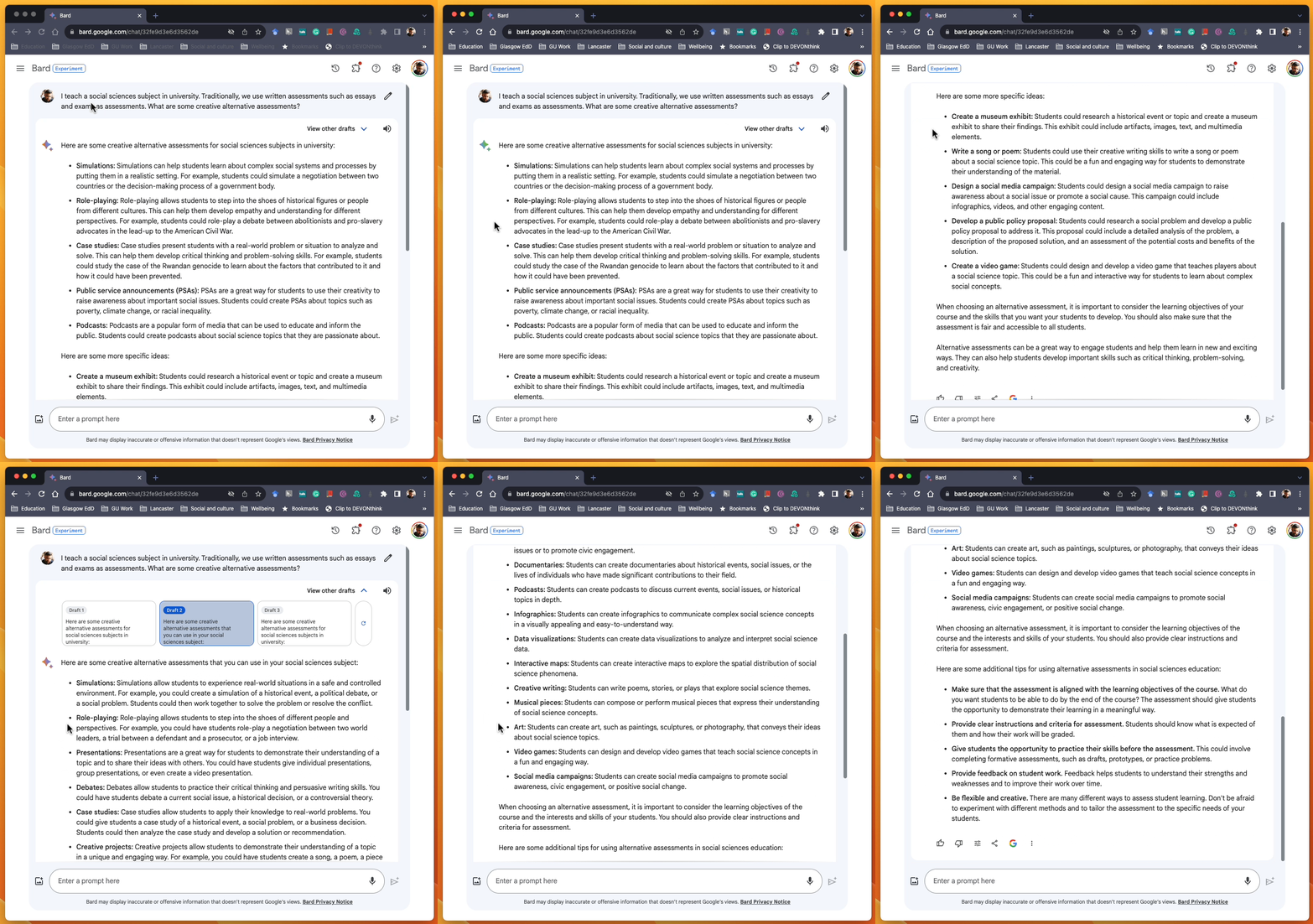
I teach a social sciences subject in university. Traditionally, we use written assessments such as essays and exams as assessments. What are some creative alternative assessments?

Reflections
In brief, similar to the first example on chemistry, both generative AI tools create a good range of creative and event collaborative assessments that you can use within your own context.
You may already use some of these, such as mind maps and portfolios. That said, there are a lot of good ideas that have been suggested that might be worth trying out. I would recommend co-creating these with students, especially if an idea appears new or innovative or out of your personal comfort zone as an educator. You may be surprised at how quickly your students take to becoming partners in learning and teaching.