Higher Education Beyond 2030: Principles, pedagogy, and the people we keep leaving out
In mid-late March 2026, I attended a session exploring the future of higher education, structured around the recently published UNESCO roadmap Transforming Higher Education: Global Collaboration on Visioning and Action (UNESCO, 2026). The room brought together academics at every career stage, from doctoral researchers to full professors, and what struck me most was not any single argument made but the collective mood: a genuine appetite for transformation sitting alongside a sober recognition of how wide the gap remains between the sector's stated values and its daily practice.
I am both a doctoral student and a university staff member, and I experience that gap from both sides simultaneously. This post is a reflection on that session and on the roadmap itself. A companion piece follows, which takes the same arguments and grounds them in the specific material conditions of Glasgow, where I work and study. What I want to do here is make the principled case about digital access, pedagogy, and whose knowledge counts, and be direct about what that case asks of educators, researchers, and policymakers.
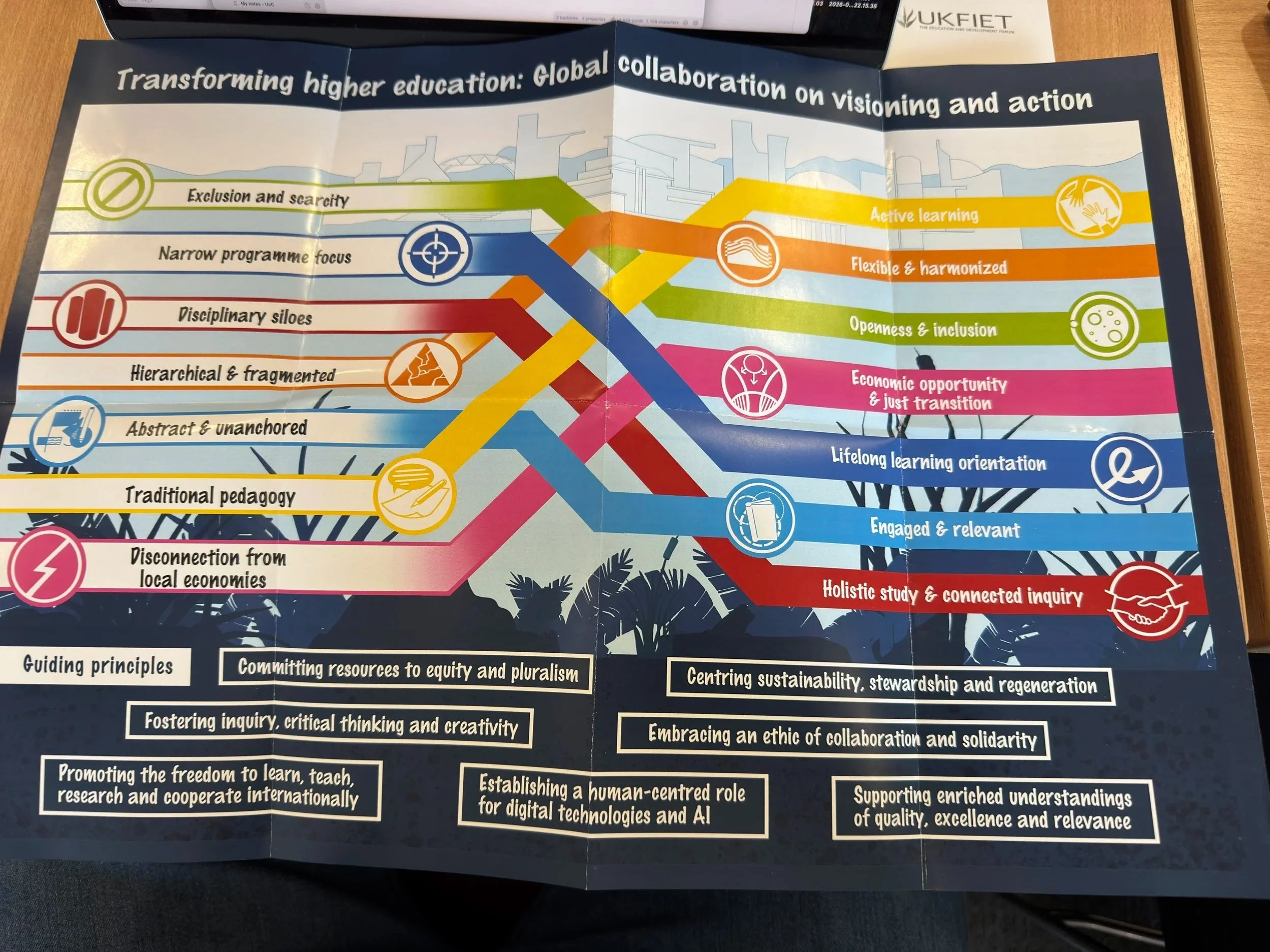
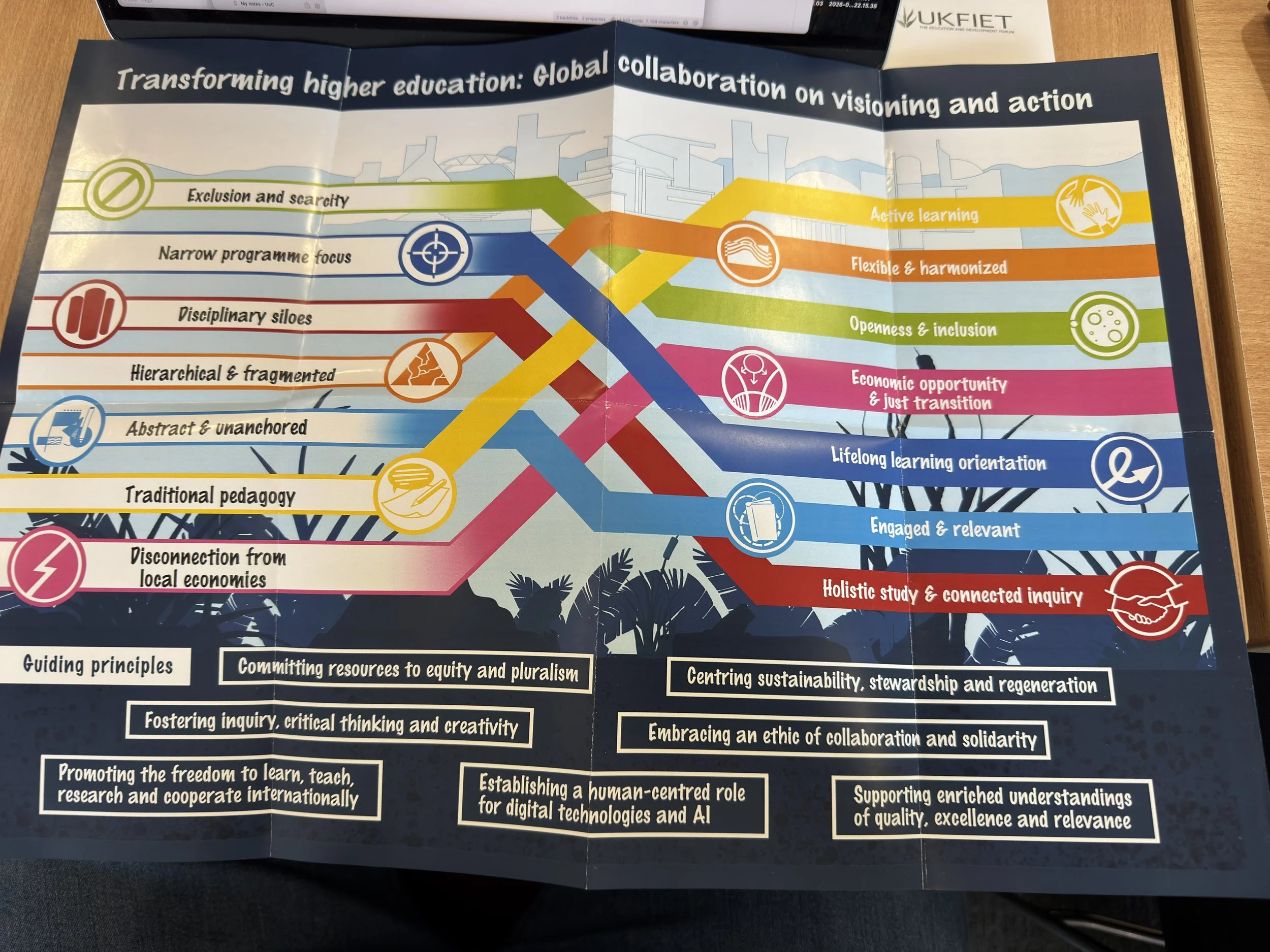
The visual from UNESCO (2026) uses a ribbon/flow diagram to map a transformation from current problems in higher education (left side) toward desired future states (right side):
Current challenges (left): exclusion and scarcity, narrow programme focus, disciplinary siloes, hierarchical and fragmented structures, abstract and unanchored learning, traditional pedagogy, and disconnection from local economies.
Transformed vision (right): active learning, flexible and harmonised systems, openness and inclusion, economic opportunity and just transition, lifelong learning orientation, engaged and relevant curricula, and holistic study and connected inquiry.
At the bottom, seven guiding principles anchor the framework: committing resources to equity and pluralism; fostering inquiry, critical thinking and creativity; promoting freedom to learn, teach, research and cooperate internationally; centring sustainability, stewardship and regeneration; embracing an ethic of collaboration and solidarity; establishing a human-centred role for digital technologies and AI; and supporting enriched understandings of quality, excellence and relevance.
Guiding principles to reshape the future of higher education (UNESCO, 2026)
The roadmap proposes seven guiding principles that are interlinked and mutually reinforcing:
Committing resources to equity and pluralism.
Promoting the freedom to learn, teach, research and cooperate internationally.
Fostering inquiry, critical thinking and creativity.
Establishing a human-centred role for digital technologies and artificial intelligence
Embracing an ethic of collaboration and solidarity.
Centring sustainability, stewardship and regeneration.
Supporting enriched understandings of quality, excellence and relevance.
The document and what it is asking of us
The UNESCO roadmap is the outcome of a remarkable consultative process: over 15,000 participants, more than 1,500 comments on a draft roadmap, and 250 knowledge products submitted from across the world. It sets out seven guiding principles and a set of lines of transformation intended to move higher education toward what it calls a new social contract. The principles call for committing resources to equity and pluralism; promoting the freedom to learn, teach, research, and cooperate internationally; fostering inquiry, critical thinking, and creativity; establishing a human-centered role for digital technologies and AI; embracing an ethic of collaboration and solidarity; centering sustainability, stewardship, and regeneration; and supporting enriched understandings of quality, excellence, and relevance (UNESCO, 2026).
What the session made clear is that many people working in higher education find these principles genuinely compelling. The hunger for a more collaborative, more inclusive, and more epistemically honest sector is real and broadly shared. What is less clear is whether institutions, as opposed to the individuals within them, are prepared to act on these principles when doing so would cost something: revenue, convenience, prestige, or the comfort of familiar ways of working.
Digital access as an equity question, not a technical one
The roadmap is explicit that enriching higher education with "the possibility to study online and/or in hybrid formats would open higher education to more diversified learner motivations and interests, as well as to those who pursue it alongside full-time employment or care work" (p. 41). It also recognizes that "students can learn in different settings and spaces, whether that be in workplaces, in communities, or different cultural settings" (p. 41).
These are not technical observations about learning management systems. They are equity arguments. And yet across the sector, a counter-movement is underway. Universities that expanded hybrid and online provision during the pandemic, often discovering in the process that engagement did not collapse and that participation from previously excluded groups increased, are now reverting to in-person-only defaults. The rationale is rarely made explicit. When it is, it tends to appeal to the value of campus community, the richness of in-person dialogue, or concerns about student isolation. These are not trivial considerations. But they are being invoked selectively, in ways that consistently favor the preferences of those for whom in-person attendance is easy over those for whom it is costly or impossible.
The roadmap's call to move from "a scarcity and exclusion mindset to an openness and inclusion paradigm" (p. 35) applies here directly. Decisions about session formats, whether a seminar, a meeting, a public lecture, or a research event is offered in hybrid form or in-person only, are not logistical defaults. They are choices about whose participation the institution is prepared to resource and whose it is prepared to make contingent on circumstances that are not equally distributed. For educators, this means thinking carefully about the assumptions embedded in format decisions that are often made without much thought at all. For policymakers, it means recognizing that guidance on hybrid provision, and the resourcing to support it properly, has not kept pace with the rhetoric of inclusion.
Collaborative assessment and the gap between what we teach and what we test
The roadmap calls for pedagogical approaches to move away from "traditional listen-and-repeat methods" and toward active, problem-based, and project-based learning. It argues that "significant learning experiences often begin with a genuinely felt problem motivating the learner" and that student-centeredness means "involving learners in their own learning, so they are the ones making connections and shaping meaning" (p. 45). The document describes the overarching aim of higher education as building "collective and individual capacities for facing our common challenges together" (p. 29).
The conversations in our session pointed to strong agreement with this direction. And yet the dominant model of assessment in higher education remains resolutely individual. Students may be invited to collaborate in seminars, workshops, and project groups. But when grades are assigned, it is nearly always the individual who is evaluated. The group is, in practice, a scaffold for solo performance.
This is not a minor inconsistency. It sends a clear signal to students about what the institution actually values, regardless of what it says about collaboration, communication, and citizenship. If we believe, as the roadmap argues, that higher education's purpose is to build people who can face shared challenges together, then assessing them only as isolated individuals is a structural contradiction at the heart of the enterprise.
The objection that collaborative assessment is difficult to do fairly is real but insufficient. These are design problems, and they are solvable. What they require is institutional will: the willingness to invest in assessment literacy among staff, to create conditions for genuine pedagogical experimentation, and to accept that the discomfort of change is not a reason to preserve a model that is increasingly misaligned with the capabilities higher education claims to develop. For researchers, this is an area where practice-based educational research can make a direct contribution. For policymakers, it is an area where quality frameworks and professional standards could do more to reward innovation in assessment design rather than defaulting to the legibility of individual grades.
Decolonization and the question of whose knowledge counts
Perhaps the most resonant theme of the session was the need to take seriously the decolonization of knowledge: not as a metaphor, a branding exercise, or a curriculum add-on, but as a fundamental rethinking of whose ways of knowing are recognized, valued, and built upon in higher education.
The roadmap is direct about this. It acknowledges that "the claims of local and indigenous knowledge systems are increasingly prevalent, with voices from the global south dismantling knowledge gatekeeping" (p. 17), and calls for universities to engage with "plural forms of knowing as these are practiced by various communities around the globe" (p. 23). In its sixth guiding principle, it calls for research and scholarship to be "democratized, decolonized and disseminated to serve the common good" (p. 31). It argues that universities must go beyond respect and tolerance to ensure that "heterogenous ways of knowing and being become a welcome and respected foundation for building futures together" (p. 23).
For educators, this demands more than adding readings from the Global South to an otherwise unchanged curriculum. It requires examining the epistemic assumptions embedded in how disciplines are structured, what counts as rigorous methodology, which citations carry authority, and whose theoretical frameworks are treated as universal while others are marked as regional or merely applied. These are uncomfortable questions for many established academics, precisely because they put the foundations of expertise under scrutiny rather than merely its contents.
For policymakers, the decolonization agenda has implications for hiring practices, research funding priorities, quality assurance frameworks, and the governance structures of universities themselves. Institutions that talk about decolonization without addressing who sits on their hiring panels, whose research agendas attract institutional investment, and how their quality metrics are constructed are engaging in a form of performativity that the roadmap is trying to move us beyond.
Crucially, as I argue in the companion piece, epistemic justice and material justice are not separable. The question of whose knowledge is centered in a curriculum cannot be fully addressed while the question of who can afford to show up to engage with it remains unresolved. Universities are simultaneously asking people to think more expansively about knowledge while making the conditions of intellectual participation materially harder for precisely the communities whose perspectives the curriculum most needs.
A note on institutional culture and the cost of belonging
There is a question worth putting to any institution that claims to take equity seriously: what does it cost someone to spend a day on your campus? Not in tuition or fees, but in the accumulated small expenditures, transport, food, a hot drink, that constitute the texture of belonging. The answer varies considerably across institutions and across the sector, and the variation is not random. It tends to reflect how seriously an institution has thought about whose comfort and whose finances it has designed itself around.
For policymakers and institutional leaders, this is worth attending to. The grand language of transformation in documents like the UNESCO roadmap finds its test not only in curriculum reform or strategic plans but in the daily, material conditions of the people the institution is supposed to serve. I take this up in much more concrete terms in the companion piece, which looks specifically at Glasgow.
Calls to action
For educators: examine the assumptions embedded in your default practices. When you schedule an in-person-only session, ask who that decision excludes and whether the exclusion is pedagogically justified. When you design an assessment, ask whether it tests the capabilities you claim to value or merely the ones that are easiest to grade individually. When you design or teach a course, ask whose knowledge its theoretical foundations are built on and whether that foundation is as universal as it has been presented.
For researchers: the gap between the transformative agenda the UNESCO roadmap describes and the practices of actual institutions is a rich and urgent site for educational research. Work that documents the equity impacts of hybrid provision decisions, evaluates collaborative assessment models, and traces the relationship between material precarity and epistemic participation is directly actionable. It does not need to wait for the sector to catch up. It can help create the conditions for it to do so.
For policymakers: the seven principles in the UNESCO roadmap are only as meaningful as the frameworks, funding mechanisms, and accountability structures that support them. Guidance on hybrid provision, investment in integrated transport where universities are anchor institutions, reform of quality frameworks to reward pedagogical innovation, and serious attention to student financial support are not peripheral concerns. They are the infrastructure on which the new social contract the roadmap calls for either stands or falls.
The roadmap closes with the observation that "transforming higher education will always be an iterative, ongoing, multilateral and intergenerational process" (p. 55). That is true. It is also, if we are not careful, a way of making peace with the distance between vision and practice. The question is not whether transformation is possible. It is whether we are prepared to begin it, seriously, now.
A companion piece, focusing on what these arguments look like in the specific context of Glasgow, its housing emergency, its fragmented transport system, and the daily material conditions of the students and staff who make up its universities, follows shortly.
References & further information
UNESCO. (2026). Transforming higher education: Global collaboration on visioning and action.
Launch event for the roadmap
A snapshot of what the document is about

Listening, Speaking, Learning: On Verbal Feedback and (Re)Humanizing Assessment

Sunset over Queens Park pond, Glasgow, UK
Recently, I listened to a podcast from 2022, Educatalks: Reflective Practice featuring Professor Melaine Coward, a professor of medical education reflect on her career and her commitment to reflective practice. Medical Educatalks is a podcast created by the Developing Medical Educators Group (DMEG) at the Academy of Medical Educators. Toward the end of the conversation, she described her decision to give students verbal feedback on their assessments. The interviewer sounded genuinely surprised, he hadn’t encountered that approach before.
I paused.
Not because it felt novel, but because it felt familiar.
In 2015, while teaching at a University of London institution, I experimented with providing verbal feedback on written assignments. At the time, our digital marking platform enabled tutors to attach audio recordings directly to students’ scripts, so feedback could be posted alongside the written work itself. Students could either listen asynchronously or book a short follow-up slot to discuss it further. I would have their script in front of me as I recorded or spoke with them, talking through strengths, misunderstandings, and next steps. It was dialogic, immediate, and relational, but it was not universally welcomed.
The pushback was swift and couched in procedural language:
How could this be standardized?
How could it be moderated?
Where was the audit trail?
Ironically, the digital system did generate an artefact. The audio file was stored alongside the script. There was a record. And yet the discomfort persisted. What seemed to trouble colleagues was not the absence of documentation, but the presence of voice, with its tone, inflection, and spontaneity. Feedback had become less easily reduced to a static text block. The underlying concern was not simply technical. It was cultural. Feedback, in this framing, was not primarily a pedagogical encounter, it was a compliance mechanism.
Listening to Coward years later, I realized something I could not fully articulate back then: verbal feedback is not merely a technique. It is an epistemological stance. It is a small but meaningful act of (re)humanising assessment.
“But what I found was, so they weren’t reading the comments that I’d spent ages putting on marking there, because I do spend time, it matters that I give good feedback. When I did recorded feedback, I found I had a lot more follow-up from students, because they had had to listen to my feedback, and it was a very clear message of, I really enjoyed this, something for you to think about. I would be quite structured in how I recorded it, so I had notes, so it was formulaic in that sense, but not rehearsed.”
Feedback as encounter, not transmission
Higher education assessment cultures are deeply shaped by what Paulo Freire famously critiqued as the “banking model” of education in Pedagogy of the Oppressed. In that model, knowledge is deposited; feedback becomes a written correction of deficits; learning is framed as remediation.
Written feedback, of course, can be thoughtful and transformative. But it often operates within systems that prioritize defensibility over dialogue. Comments are calibrated for external examiners. Language becomes cautious. Tone becomes formal and neutralized. The student becomes a case.
Audio feedback, even when delivered asynchronously through a digital platform, subtly shifts that dynamic. Students hear emphasis. They hear encouragement. They hear uncertainty where appropriate. Meaning is shaped not only by what is said, but how it is said.
And when audio is paired with optional follow-up conversation, feedback becomes dialogic in a deeper sense. Students can respond, query, reinterpret.
This resonates with Freire’s insistence on dialogue as the foundation of emancipatory education. It also aligns with bell hooks’ vision of engaged pedagogy in Teaching to Transgress, where teaching and learning are relational acts rather than one-way transmissions.
When we speak with students rather than at them, feedback becomes less about surveillance and more about growth. Voice, literal voice, reintroduces presence into assessment by (re)humanizing it.
The standardization question
The resistance I encountered in 2015 revolved around standardisation. Written comments were seen as stable, recordable, and therefore fair. Audio feedback, even though stored and retrievable, was viewed as potentially variable.
But here is the uncomfortable truth: standardization is not synonymous with justice.
Critical and decolonial scholars have long questioned whose norms assessment criteria encode. Ngũgĩ wa Thiong'o, in Decolonising the Mind, reminds us that language and evaluation are never neutral; they are embedded within colonial power structures. Similarly, scholars of antiracist pedagogy argue that assessment practices often privilege dominant linguistic and epistemic norms and performances.
Audio feedback can surface some of this hidden curriculum. It allows educators to unpack what we mean by “criticality” or “coherence” in accessible, responsive ways. It can soften deficit framings by conveying nuance and care. It can make tacit expectations explicit.
For neurodivergent students, multilingual students, or those unfamiliar with disciplinary conventions, hearing feedback, with tone and pacing, can support comprehension in ways that dense written comments may not.
Uniform delivery formats may be easier to audit. But equity sometimes requires responsiveness.
Reflective practice and professional identity
Coward’s framing of verbal feedback emerged from reflective practice, a concept often associated with Donald Schön and his work The Reflective Practitioner. Reflection is not merely about improving technique; it is about interrogating the assumptions that underpin our actions.
Looking back, I can see that my 2015 experience exposed a tension between two logics and a clash of paradigms:
Assessment as pedagogical relationship / Was feedback a compliance mechanism or a pedagogical relationship?
Assessment as quality assurance infrastructure / Was my role to produce defensible documentation or to cultivate understanding?
The digital tool itself was neutral. It could host text or voice. The debate was about what counted as legitimate academic labor and legitimate evidence of fairness.
Reflective practice asks us to interrogate not only how we teach, but why certain practices are normalized while others are treated as suspect.
(Re)humanizing assessment in digital spaces
In my current work, including conversations around decolonizing curricula and rethinking assessment, I often return to a simple question:
What would assessment look like if we centered humanity rather than auditability?
This is not an argument to abandon rigor or documentation. Rather, it is a call to re-balance priorities.
(Re)humanizing assessment might include:
Dialogic feedback conversations alongside written summaries
Audio or video feedback that conveys tone and relational presence
Opportunities for students to respond to feedback
Co-constructed criteria discussions
Assessment designs that value multiple ways of knowing
These moves resonate with broader critical pedagogical commitments: resisting neoliberal metrics, challenging deficit framings, and recognizing students as co-participants in knowledge production. These moves further resonate with critical pedagogy’s insistence on dialogue, with antiracist commitments to challenging hidden norms, and with decolonial calls to unsettle inherited hierarchies of knowledge.
They also align with emerging scholarship on compassionate pedagogy and relational assessment cultures within higher education.
“Hearing someone talk about what you’ve done, the tone and voice to highlight praise, concern, and you can add in a more questioning tone ... They loved it. They loved it because they could hear from my touch. ”
An epiphany, years later: are our systems human enough?
Listening to Coward describe her practice, I felt both affirmed and reflective. The surprise expressed by the podcast interviewer revealed how deeply entrenched written, standardized feedback remains. Yet the fact that such practices continue to surface across disciplines, from medical education to the humanities, suggests a quiet shift. I also felt less concerned with whether verbal feedback is innovative and more interested in what it reveals. What I once framed defensively as “innovative feedback” now feels more clearly like a small act of resistance against depersonalized academic systems.
Even when captured and archived in a digital platform, voice unsettles the fantasy that assessment can be entirely standardised and neutral. It reintroduces tone, care, and relational accountability.
Perhaps the question is not whether audio feedback can be moderated.
Perhaps the more urgent question is whether our assessment cultures allow space for humanity, for dialogue, for nuance, for recognition.
If critical, antiracist, and decolonial pedagogies ask us to re-centre people rather than processes, then even something as simple as attaching a recorded voice note to a script can become a quietly radical act.
Suggested further reading
Pedagogy of the Oppressed – Paulo Freire
Teaching to Transgress – bell hooks
Decolonising the Mind – Ngũgĩ wa Thiong'o
A Handbook of Reflective and Experiential Learning – Jennifer A. Moon
The Reflective Practitioner – Donald Schön
And, of course, I would recommend listening to Educatalks: Reflective Practice featuring Melaine Coward, not because verbal feedback is revolutionary, but because reflective conversations about practice remind us that teaching is, at its heart, relational work.
In a sector increasingly governed by metrics, that reminder feels quietly radical.

Using generative AI for everyday writing
As part of my role, I’m experimenting with generative AI as part of my role within the Learning Innovation Support Unit at the University of Glasgow.
In the short post, I look at using generative AI for everyday writing tasks from the perspective of anyone working in tertiary education. So, whether you work in a college in the US or UK sense or a university as an administrator, educator or research staff, this post applies to you.
Overview
I look at examples from Google Bard and chatGPT 3.5. Specifically, I look at using generative AI for:
turning draft notes into prose
writing a welcome message to new students, and tweaking messages
writing a message in a specific literary style
writing for specific audiences
drafting and redrafting
By using these examples, I try to show what two different generative AI tools can do. I also briefly discuss their limitations.
This post will help anyone in education other environments understand how to use generative AI for everyday writing tasks.
Turning meeting notes into prose
Sometimes you might need to write up notes taken into a meeting into a prose, something that is coherent and to be read by others. Generative AI can help with this. Here are two examples that I used using the following prompt:
I have some draft notes from a meeting. Can you turn this into prose?
Reflections: defining vs storytelling?
As you’ll see from the drop-down boxes below, my original notes are transformed in different ways by Google Bard and chatGPT 3.5, respectively. My original notes were a set of bullet-pointed items, as I was taking these in the moment while in a meeting with two other colleagues. I wanted to jot down basic information quicky. These notes might come in handy later, for example when I need to put together a report.
Interestingly, Google Bard keeps the bullet points and expanded them with some prose by perhaps defining each area or student population. The focus here seems to be on defining what the student groups are. The response is short. However, Google Bard also did create two other drafts. You can see a screenshot of a second draft below.
chatGPT, however, creates paragraphs that seem to create a story or argument. The emphasis is less on defining who the student groups are and more on storytelling what they might bring to the course in question.
This contrast is important to consider because writing for your audience matters. Understanding who your audience is will make a difference in the kind of response you want or need to create.
-
course audience
non-traditional students
people with lived experiences
returners to study
mature students
academic areas
social/public policy students
local government practices and policy
urban studies students?
social work
experienced people
new people
social justice
public health
social welfare
decolonization / decolonizing education and systemstion
-
The course audience encompasses a diverse range of individuals, making it a dynamic and inclusive learning environment. Primarily, it caters to non-traditional students, particularly those with unique lived experiences that contribute to the richness of classroom discussions. This group often includes individuals returning to the academic sphere after an absence, mature students seeking new knowledge and skills, and those pursuing studies in various academic disciplines.
Among the academic areas represented within the course are social and public policy students, with a focus on local government practices and policy. Here, students delve into the intricate workings of governance at the local level, exploring policies that impact communities directly.
Another segment of the audience consists of urban studies students, who examine the complexities of urban environments, including their design, development, and social implications.
Social work students, both seasoned professionals and newcomers to the field, engage in discussions related to their practice. This diverse group brings real-world experiences and fresh perspectives to the table.
Furthermore, the course appeals to students interested in social justice, public health, social welfare, and the critical concept of decolonization. It offers a platform for dialogue on creating equitable systems, dismantling colonial legacies, and promoting social change.
In essence, this course fosters an inclusive and collaborative learning environment, bringing together individuals from various backgrounds and academic interests to explore critical issues that shape our society.
-
The course audience is likely to be a diverse group of students, including:
Non-traditional students: This could include people who have not followed a traditional educational path, such as those who have delayed their education or who have returned to school after a break.
Returners to study: Students who are returning to school after a period of absence, such as those who are raising a family or who have been working full-time.
Mature students: Students who are over the traditional age of entry for higher education.
Academic areas:
Social/public policy students: Students who are interested in studying social and public policy, such as local government practices and policy.
Urban studies students: Students who are interested in studying urban areas and the challenges and opportunities they face.
Social work students: Students who are interested in a career in social work, helping people in need and advocating for social justice.
Social justice students: Students who are passionate about social justice and want to learn more about how to make the world a more equitable place.
Public health students: Students who are interested in studying public health and promoting the health and well-being of populations.
Social welfare students: Students who are interested in studying social welfare and the policies and programs that support people in need.
Decolonization students: Students who are interested in studying decolonization and decolonizing education and systems.
The course is likely to be of interest to students from a variety of backgrounds and with a range of experiences. It is particularly relevant to students who are interested in making a difference in the world and who are committed to social justice.
chatGPT & Google Bard in action
Below are two gif animations of the prompts I used and the responses from Google Bard and chatGPT, respectively. As you can see, chatGPT creates one response. You can then write follow-up prompts to hone the response(s) that you want. Google Bard will provide 3 drafts (at least) and you can choose from these and/or write follow-up prompts for further drafts.
NB: Clicking on an image will enlarge it.


Drafting a welcome message to new students
Generative AI can also be helpful in creating templates that you can modify to your needs. One example is creating a welcome message to new students and/or staff. You may already have one. However, it’s always good to refresh these as time goes on.
For these, examples, you can see the results yourself from Google Bard and chatGPT 3.5, respectively or see the images below.
Here’s the prompt I used in both genAI tools:
I'm a program administrator. I'd like to draft a short welcome message to new students. The tone should be professional and friendly. The message should be no more than 2 paragraphs long.

Google Bard’s response
Interestingly, it ends with tips on writing. The response appears a little more personal than the one created by chatGPT.

chatGPT 3.5’s response
This reads somewhat similar to the response by Google Bard but it’s a lot shorter and to the point.
Testing the creativity of generative AI: using literary styles for welcome messages
I decided to test how Google Bard and chatGPT 3.5 might respond if I asked them to re-write the welcome messages to students in the style of Audre Lorde and Robert Burns. I used Google Bard for Audre Lorde, and chatGPT 3.5 for Robert Burns.
You can judge the results for yourself!
-
Welcome, new students.
This is a space for you to learn and grow, to challenge yourself and to be challenged.
It is a space for you to find your voice and to use it.
To stand up for what you believe in, even when it is difficult.
To be your full, authentic self.
We are here to support you on your journey.
But we cannot do it for you.
You must do the work.
You must be brave enough to ask the hard questions.
You must be willing to be uncomfortable.
You must be open to new ideas and new perspectives.
And you must be willing to share your own.
This is your time.
Make the most of it.
In solidarity,
[Your name]
Program Administrator
-
Dear Newcomers, ye're welcome here,
As Administrator, I give ye cheer.
Ye've chosen well to join our fold,
In learning's path, ye'll soon be bold.
Through study's journey, find your way,
With staff to guide, by night and day.
Questions and concerns, don't ye hide,
We're here to help, walk by your side.
But ne'er forget, in this abode,
The heart of learning, by community sowed.
Connect with peers, as the seasons turn,
Together we'll thrive, together we'll learn.
For in our bonds, our strength is found,
As we explore knowledge all around.
Welcome to our program's embrace,
A transformative journey, yer destiny's grace.
Warm regards,
[Your Name]
Program Administrator
Drafting & redrafting tips for new students

Greeting new students, no matter their age or level, can be an opportunity to spark many things: interests, hope, enthusiasm, change, development and many others.
Let’s see what generative AI creates for the following prompt:
I teach first year undergraduate students. Create a list of 10 good tips for students new to a university. Keep the tone supportive and friendly.
As we can see below, the responses are quite similar. Depending on where you teach and work, you’ll want to modify some of the language. We can see that the language below is heavily geared towards locations where academics or lecturers are called ‘professors’ (looking at you, USA!).
Interestingly, Google Bard’s response puts emphasis on trying things out and embracing learning from failure, whereas chatGPT seems to avoid mentioning this at all while instead encouraging people to remain positive. Neoliberal much?
chatGPT 3.5’s response
Stay Organized: Keep a planner or use digital tools to stay on top of assignments, deadlines, and class schedules. Being organized will reduce stress and help you manage your time effectively.
Ask Questions: Don't hesitate to ask your professors, advisors, or fellow students for help or clarification. Everyone is here to support your learning journey, and questions are a vital part of the process.
Engage in Class: Active participation in class discussions and activities can enhance your learning experience and build valuable connections with your peers and professors.
Explore Resources: Universities offer a wealth of resources, from libraries to tutoring centers to counseling services. Take advantage of these resources to excel academically and personally.
Balance Your Life: University life is about more than just studying. Make time for hobbies, socializing, and self-care. Finding a healthy balance is essential for your well-being.
Make Connections: Building relationships with classmates can lead to lasting friendships and valuable study groups. Attend club meetings, events, and orientation sessions to meet new people.
Stay Curious: University is an opportunity to explore new ideas and perspectives. Embrace the chance to broaden your horizons and approach subjects with an open mind.
Seek Feedback: Don't be afraid to request feedback on your assignments or exams. Understanding where you can improve is a crucial part of your growth as a student.
Stay Positive: University can be challenging, but remember that setbacks are part of the learning process. Stay positive, persevere through challenges, and celebrate your successes, no matter how small.
Plan for the Future: While enjoying your first year, start thinking about your long-term goals and career aspirations. University is not only about education but also about preparing for your future.
Welcome to the university journey! We're excited to have you here, and we're confident that you'll thrive with these tips in mind. Remember, you're not alone in this adventure, and there's a whole community here to support you.
Google Bard’s response
Get organized. This means creating a study schedule, finding a good place to study, and keeping track of your assignments and deadlines. There are many resources available to help you get organized, such as your university's academic advising center or student success center.
Don't be afraid to ask for help. If you're struggling in a class, talk to your professor or teaching assistant. They can provide you with extra help and support. You can also join a study group or talk to a tutor.
Get involved in extracurricular activities. This is a great way to meet new people, learn new skills, and have fun. There are many different clubs and organizations to choose from, so you're sure to find something that interests you.
Take care of yourself. This means getting enough sleep, eating healthy foods, and exercising regularly. It also means taking breaks from studying and socializing with friends. Taking care of yourself will help you stay focused and motivated.
Don't be afraid to make mistakes. Everyone makes mistakes, especially when they're first starting out. The important thing is to learn from your mistakes and move on.
Celebrate your successes. No matter how small they may seem, it's important to celebrate your successes. This will help you stay motivated and keep moving forward.
Find a mentor. A mentor is someone who can provide you with guidance and support. They can be a professor, a teaching assistant, an older student, or someone in your field of study.
Use your university's resources. Your university has many resources available to help you succeed, such as the library, the writing center, and the career counseling center. Take advantage of these resources!
Don't be afraid to try new things. University is a time to explore your interests and try new things. Take classes outside of your major, try out for a sports team, or join a club that you're interested in.
Have fun! University is a time to learn and grow, but it's also a time to have fun. Make memories with your friends, go to sporting events and concerts, and explore your new city.
Additional tips:
Be proactive in your learning. Don't wait until the night before an exam to start studying. Start early and give yourself plenty of time to prepare.
Don't be afraid to speak up in class. Ask questions and participate in discussions. The more involved you are, the more you will learn.
Take advantage of your professors' office hours. If you're struggling in a class, don't be afraid to go to your professor's office hours for help. They are there to help you succeed.
Don't be afraid to fail. Everyone fails at some point in their lives. The important thing is to learn from your failures and keep moving forward.
I hope these tips are helpful! Welcome to university!
Diving deeper into making connections
I think making and sustaining connections in education is very important for success. It helps to have people to bounce ideas off, to get alternative perspectives and takes on the same or similar readings. So, I wanted to see what chatGPT 3.5 would respond to expanding on point 6 ‘Make connections’. I asked ‘Can you expand upon point 6'?’ and here is what it responded with:
Certainly! Point 6, "Make Connections," is not just about meeting people but also about creating a network that can enhance your university experience and future opportunities. Here's an expanded version of this tip:
6. Make Connections: Build Your University Network
One of the most enriching aspects of university life is the chance to connect with a diverse group of people. These connections can shape your academic experience, personal growth, and even your future career. Here's how to make the most of this opportunity:
a. Attend Campus Events: Universities often host a wide range of events, from club meetings to guest lectures and cultural festivals. Attend these gatherings to meet fellow students who share your interests and passions. It's a great way to find like-minded friends and explore your hobbies.
b. Join Clubs and Organizations: Most universities have numerous clubs and student organizations that cater to a variety of interests. Whether you're into sports, arts, social activism, or academic pursuits, there's likely a group for you. Joining clubs not only helps you make friends but also provides opportunities for leadership and personal development.
c. Participate in Orientation: Many universities organize orientation programs for new students. These events are designed to help you get to know your campus, fellow students, and university resources. Take advantage of them to start building connections from day one.
d. Study Groups: Collaborative learning can be incredibly effective. Forming or joining study groups can help you better understand complex subjects, share knowledge, and develop lasting friendships with your peers.
e. Network with Professors: Your professors are valuable resources for both academic and career advice. Attend office hours to discuss your coursework, seek guidance on research projects, and build professional relationships that can provide references or mentorship.
f. Connect Virtually: In the digital age, online platforms and social media are powerful tools for staying connected with classmates, professors, and alumni. LinkedIn, for instance, is a great platform for building your professional network.
g. Be Inclusive: University is a place of diversity, and it's an opportunity to interact with people from various backgrounds and cultures. Embrace inclusivity, be open to different perspectives, and learn from the richness of this diversity.
Remember, the connections you make in university can extend far beyond your time on campus. These relationships can lead to lifelong friendships, career opportunities, and a broader understanding of the world. So, take the initiative, be open to new experiences, and enjoy the journey of building your university network.
Reflections: pushing generative AI
When I asked chatGPT 3.5 to give examples of apps where students could connect virtually, the responses were overwhelmingly biased towards Anglo-American/Eurocentric apps such as
Zoom
Microsoft Teams
Slack
Discord
TikTok
Snapchat
I had to specifically ask about common social media apps that non-English speakers might use, and chatGPT finally spilled the beans by suggesting:
WeChat - an all-in-one messaging app widely used in China
Line - a messaging app with a strong presence in Asia. It offers stickers, games, and a variety of features in addition to messaging.
VK (VKontakte) - a Russian-language social media platform similar to Facebook. It offers features for connecting with friends, sharing media, and joining communities. It’s popular in Russian speaking areas.
I wanted to push it a bit as I know that tools like Google Bard and chatGPT will reproduce cultural biases and norms through the suggestions that they create. Omissions are almost always there, so further questioning can help to get more clarity out of generative AI tools.