Critical AI Engagement Framework
NB: This page was original published 24 March 2026, and has since been updated on 21 May 2026 to reflect the latest framework iteration (Version 1.4). A further update was made on 26 August to add the interactive version of the framework, available on a separate page.
This framework draws on Hosseini's (2026) forthcoming paper in The Geographical Journal, which examines how generative AI tools reproduce racial, gendered, and class-based representations through algorithmic coloniality (Mohamed et al., 2020). That work demonstrates how seemingly neutral prompts encode dominant cultural assumptions, producing outputs that reflect and reinforce existing inequalities.
The Critical AI Engagement Framework extends this analysis into a practical pedagogical tool, mapping how individuals engage with generative AI across two axes: epistemic posture and structural consciousness. It is designed for use across educational contexts, supporting educators and learners in moving beyond prompt refinement toward critical, collective, and structurally informed engagement with AI systems.
April 2026 update: the paper informing this framework has now been published and is available below.
May 2026 update: version 1.4 of the framework is towards the end of this page.
August 2026 update: you can find an interactive and mobile-friendly version fo the Critical AI Framework at the following page.
Hosseini, D. D. 2026. “Generative AI: A Problematic Illustration of the Intersections of Race, Gender and Class.” The Geographical Journal 192, no. 2: e70085. https://doi.org/10.1111/geoj.70085.
Generative AI tools are now embedded in higher education, used to draft text, generate images, produce code, and synthesise research. Yet these tools are not neutral. They encode the assumptions, hierarchies, and exclusions of the data they were trained on, reproducing patterns of racial, gendered, and class-based harm even as their outputs become more sophisticated (Benjamin, 2019; Mohamed et al., 2020; Noble, 2018). Understanding how students engage with these tools, and what that engagement does or does not interrogate, is therefore an urgent task for educators.
The Critical AI Engagement Framework maps educational engagement with generative AI across two axes. The horizontal axis describes an individual’s epistemic posture toward AI: from treating its outputs as authoritative, through questioning them, to recognising the colonial and structural conditions that shape what AI knows, whose knowledge it centres, and what it silences (Hosseini, 2026; Maalsen, 2023). The vertical axis describes how far an individual recognises AI as a socio-technical artefact shaped by relations of power, rather than simply a tool with fixable flaws (Benjamin, 2019; Quijano, 2000; Zembylas, 2023). The positions individuals occupy are not freely chosen but reflect the institutional, curricular, and social conditions that shape how they learn and work. The framework’s aspiration is not a more capable individual user but collective action: sustained, community-grounded engagement that works toward structural change (Camacho Felix, 2025; Mohamed et al., 2020).
neutral & apolitical
lacks systemic account
coloniality & harm
Critical AI Engagement Framework Version 1.4
This version adds in the researcher lens and concepts such as epistemic accountability and the research lifecycle.
Generative AI tools are now embedded in higher education, used to draft text, generate images, produce code, and synthesise research. Yet these tools are not neutral. They encode the assumptions, hierarchies, and exclusions of the data they were trained on, reproducing patterns of racial, gendered, and class-based harm even as their outputs become more sophisticated (Benjamin, 2019; Mohamed et al., 2020; Noble, 2018). Understanding how students engage with these tools, and what that engagement does or does not interrogate, is therefore an urgent task for educators.
The Critical AI Engagement Framework maps educational engagement with generative AI across two axes. The horizontal axis describes an individual’s epistemic posture toward AI: from treating its outputs as authoritative, through questioning them, to recognizing the colonial and structural conditions that shape what AI knows, whose knowledge it centers, and what it silences (Hosseini, 2026; Maalsen, 2023). The vertical axis describes how far an individual recognizes AI as a socio-technical artefact shaped by relations of power, rather than simply a tool with fixable flaws (Benjamin, 2019; Quijano, 2000; Zembylas, 2023). The positions individuals occupy are not freely chosen but reflect the institutional, curricular, and social conditions that shape how they learn and work. The framework’s aspiration is not a more capable individual user but collective action: sustained, community-grounded engagement that works toward structural change (Camacho Felix, 2025; Mohamed et al., 2020).
neutral & apolitical
lacks systemic account
coloniality & harm
This view reframes the framework for researchers engaging with generative AI across the research process. The two applied sections in each cell address the researcher's own practice and the dimension of epistemic accountability — a concept that holds together citational justice (the obligation to credit ideas and intellectual labour whether or not they appear in a formal reference list) and research integrity (the obligation to be transparent about the conditions, limitations, and role of AI in knowledge production). Together they ask: is this knowledge claim accountable — to its sources, its methods, and the communities it draws on?
Positions are not fixed. A researcher may occupy different cells across different phases of the research lifecycle, and across different relationships — with their own field, with collaborators, with communities whose knowledge they draw on.
neutral & apolitical
lacks systemic account
coloniality & harm
This view adds epistemic accountability as a fourth dimension alongside the original three sections. Epistemic accountability holds together two obligations that AI use makes newly urgent: citational justice — recognising whose ideas are absorbed through AI-mediated synthesis and naming intellectual contributions that fall outside formal citation conventions — and research integrity — being transparent about the conditions, limitations, and role of AI in knowledge production. Neither subordinates the other. Citational justice asks whose labour is acknowledged; research integrity asks whether the conditions of production are honestly disclosed. Together they ask: is this knowledge claim accountable — to its sources, its methods, and the communities it draws on?
This view preserves the educational framing (theoretical anchor, for educators, for students) and adds epistemic accountability as a cross-cutting dimension that applies regardless of whether the user is a researcher, educator, or student. AI use in educational contexts raises the same questions of intellectual credit, attribution transparency, and relational accountability as it does in formal research.
neutral & apolitical
lacks systemic account
coloniality & harm
This view maps AI engagement across the research lifecycle, tracing how epistemic posture — from deference to collective agency — manifests differently at each phase of research practice. Each phase carries distinct risks and possibilities: the literature and framing phase is where AI most aggressively shapes what counts as relevant scholarship; methodology and design is where colonial defaults in AI recommendations become embedded in the research architecture; data and evidence is where AI's training hierarchies most directly affect what gets surfaced and what gets buried; analysis and interpretation is where AI can flatten the conceptual moves that distinguish critical from descriptive work; writing and synthesis is where citational erasure is most invisible; and publication and dissemination is where structural change is most possible — and most resisted.
The epistemic accountability dimension (gold) runs through all phases but intensifies toward dissemination. It addresses two obligations simultaneously: citational justice — whose intellectual labour is acknowledged, including named authors, unnamed collaborators, community knowledge, conversations, and ideas that circulate before they are published — and research integrity — transparent disclosure of how AI was used, what it could not see, and what structural conditions shaped the knowledge produced. Both are present at every phase; the balance between them shifts as the research progresses.
The phase where AI most aggressively determines whose scholarship counts as foundational. Epistemic deference here shapes the entire conceptual architecture of the research.
AI methodology recommendations embed epistemological defaults — which methods count as rigorous, whose frameworks are treated as standard — that shape what the research can find before data collection begins.
AI's training hierarchies directly affect what gets surfaced and what gets buried. At this phase, algorithmic coloniality is most materially consequential — shaping whose experiences, voices, and data are treated as valid evidence.
AI analysis flattens complexity and forecloses interpretive possibilities. The conceptual moves that distinguish critical from descriptive research are most at risk here — as AI tends toward synthesis, consensus, and the resolution of tension.
Citational erasure is most invisible at this phase. AI-assisted writing absorbs ideas, framings, and formulations without tracing them to their origins — and researchers may not notice because the output reads as their own.
The phase where structural change is most possible and most resisted. Publishing choices — venue, format, access, co-authorship conventions — are themselves political acts that reproduce or challenge the knowledge hierarchies AI encodes.
Higher Education Beyond 2030: Principles, pedagogy, and the people we keep leaving out
In mid-late March 2026, I attended a session exploring the future of higher education, structured around the recently published UNESCO roadmap Transforming Higher Education: Global Collaboration on Visioning and Action (UNESCO, 2026). The room brought together academics at every career stage, from doctoral researchers to full professors, and what struck me most was not any single argument made but the collective mood: a genuine appetite for transformation sitting alongside a sober recognition of how wide the gap remains between the sector's stated values and its daily practice.
I am both a doctoral student and a university staff member, and I experience that gap from both sides simultaneously. This post is a reflection on that session and on the roadmap itself. A companion piece follows, which takes the same arguments and grounds them in the specific material conditions of Glasgow, where I work and study. What I want to do here is make the principled case about digital access, pedagogy, and whose knowledge counts, and be direct about what that case asks of educators, researchers, and policymakers.
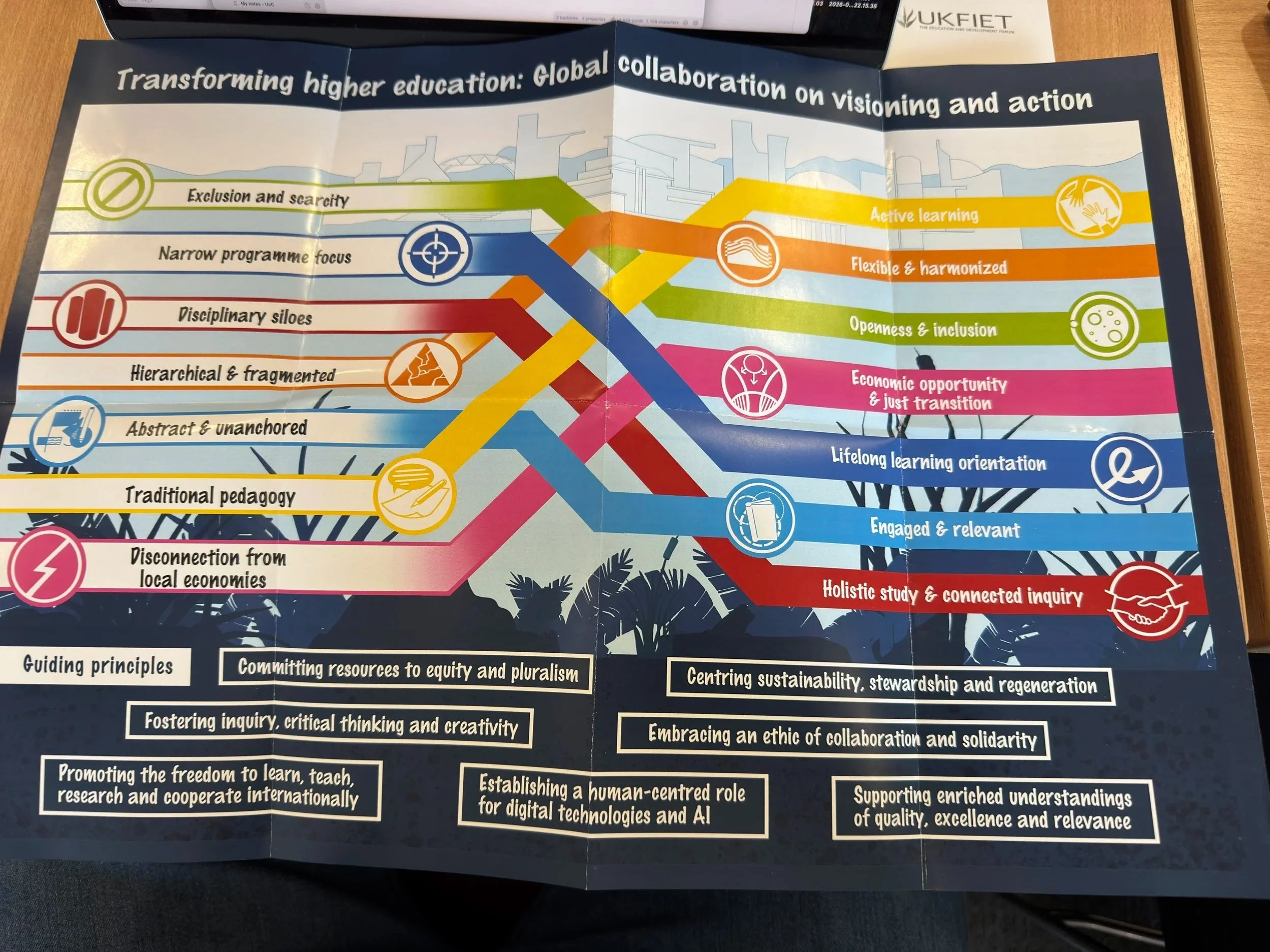
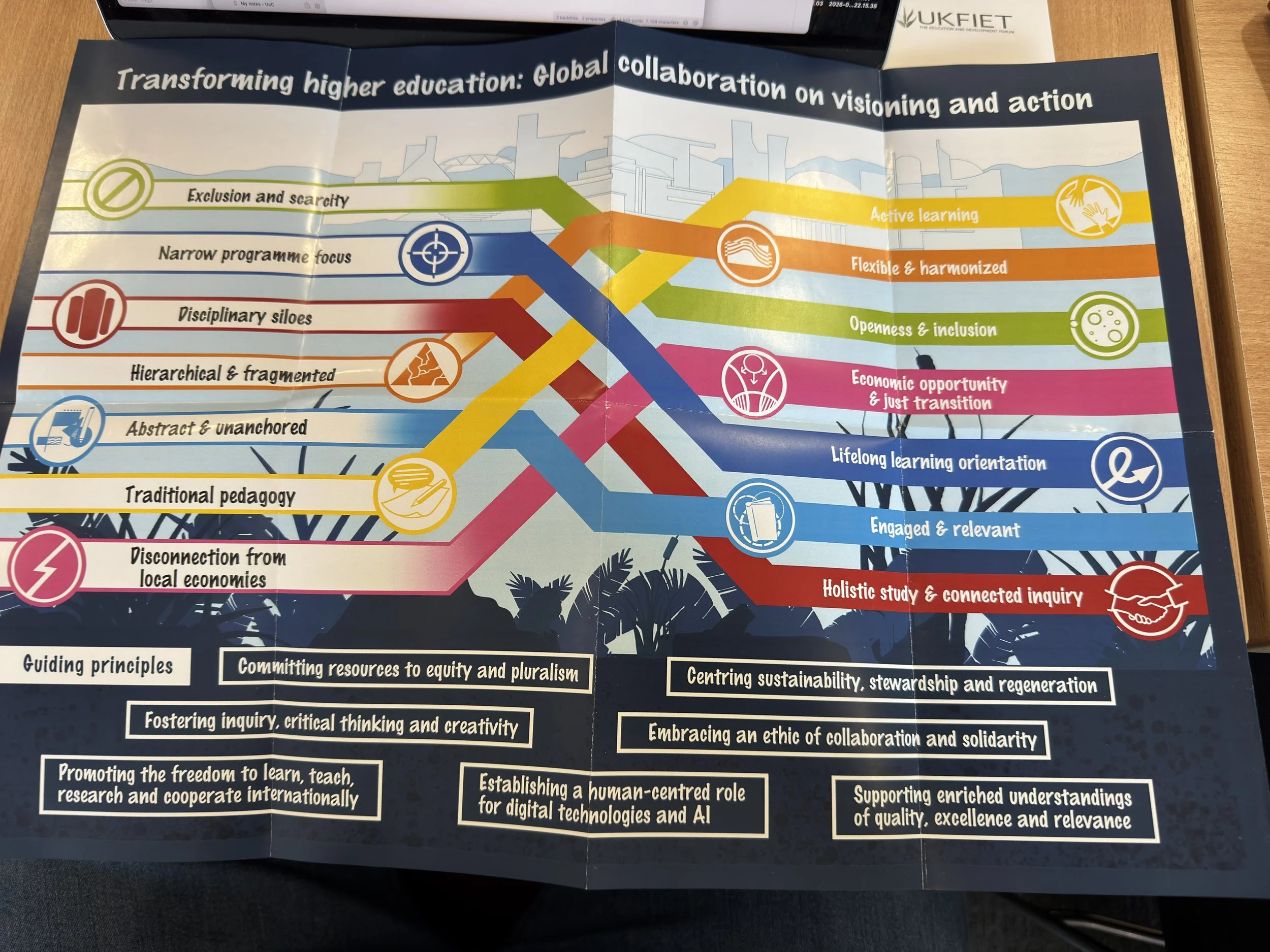
The visual from UNESCO (2026) uses a ribbon/flow diagram to map a transformation from current problems in higher education (left side) toward desired future states (right side):
Current challenges (left): exclusion and scarcity, narrow programme focus, disciplinary siloes, hierarchical and fragmented structures, abstract and unanchored learning, traditional pedagogy, and disconnection from local economies.
Transformed vision (right): active learning, flexible and harmonised systems, openness and inclusion, economic opportunity and just transition, lifelong learning orientation, engaged and relevant curricula, and holistic study and connected inquiry.
At the bottom, seven guiding principles anchor the framework: committing resources to equity and pluralism; fostering inquiry, critical thinking and creativity; promoting freedom to learn, teach, research and cooperate internationally; centring sustainability, stewardship and regeneration; embracing an ethic of collaboration and solidarity; establishing a human-centred role for digital technologies and AI; and supporting enriched understandings of quality, excellence and relevance.
Guiding principles to reshape the future of higher education (UNESCO, 2026)
The roadmap proposes seven guiding principles that are interlinked and mutually reinforcing:
Committing resources to equity and pluralism.
Promoting the freedom to learn, teach, research and cooperate internationally.
Fostering inquiry, critical thinking and creativity.
Establishing a human-centred role for digital technologies and artificial intelligence
Embracing an ethic of collaboration and solidarity.
Centring sustainability, stewardship and regeneration.
Supporting enriched understandings of quality, excellence and relevance.
The document and what it is asking of us
The UNESCO roadmap is the outcome of a remarkable consultative process: over 15,000 participants, more than 1,500 comments on a draft roadmap, and 250 knowledge products submitted from across the world. It sets out seven guiding principles and a set of lines of transformation intended to move higher education toward what it calls a new social contract. The principles call for committing resources to equity and pluralism; promoting the freedom to learn, teach, research, and cooperate internationally; fostering inquiry, critical thinking, and creativity; establishing a human-centered role for digital technologies and AI; embracing an ethic of collaboration and solidarity; centering sustainability, stewardship, and regeneration; and supporting enriched understandings of quality, excellence, and relevance (UNESCO, 2026).
What the session made clear is that many people working in higher education find these principles genuinely compelling. The hunger for a more collaborative, more inclusive, and more epistemically honest sector is real and broadly shared. What is less clear is whether institutions, as opposed to the individuals within them, are prepared to act on these principles when doing so would cost something: revenue, convenience, prestige, or the comfort of familiar ways of working.
Digital access as an equity question, not a technical one
The roadmap is explicit that enriching higher education with "the possibility to study online and/or in hybrid formats would open higher education to more diversified learner motivations and interests, as well as to those who pursue it alongside full-time employment or care work" (p. 41). It also recognizes that "students can learn in different settings and spaces, whether that be in workplaces, in communities, or different cultural settings" (p. 41).
These are not technical observations about learning management systems. They are equity arguments. And yet across the sector, a counter-movement is underway. Universities that expanded hybrid and online provision during the pandemic, often discovering in the process that engagement did not collapse and that participation from previously excluded groups increased, are now reverting to in-person-only defaults. The rationale is rarely made explicit. When it is, it tends to appeal to the value of campus community, the richness of in-person dialogue, or concerns about student isolation. These are not trivial considerations. But they are being invoked selectively, in ways that consistently favor the preferences of those for whom in-person attendance is easy over those for whom it is costly or impossible.
The roadmap's call to move from "a scarcity and exclusion mindset to an openness and inclusion paradigm" (p. 35) applies here directly. Decisions about session formats, whether a seminar, a meeting, a public lecture, or a research event is offered in hybrid form or in-person only, are not logistical defaults. They are choices about whose participation the institution is prepared to resource and whose it is prepared to make contingent on circumstances that are not equally distributed. For educators, this means thinking carefully about the assumptions embedded in format decisions that are often made without much thought at all. For policymakers, it means recognizing that guidance on hybrid provision, and the resourcing to support it properly, has not kept pace with the rhetoric of inclusion.
Collaborative assessment and the gap between what we teach and what we test
The roadmap calls for pedagogical approaches to move away from "traditional listen-and-repeat methods" and toward active, problem-based, and project-based learning. It argues that "significant learning experiences often begin with a genuinely felt problem motivating the learner" and that student-centeredness means "involving learners in their own learning, so they are the ones making connections and shaping meaning" (p. 45). The document describes the overarching aim of higher education as building "collective and individual capacities for facing our common challenges together" (p. 29).
The conversations in our session pointed to strong agreement with this direction. And yet the dominant model of assessment in higher education remains resolutely individual. Students may be invited to collaborate in seminars, workshops, and project groups. But when grades are assigned, it is nearly always the individual who is evaluated. The group is, in practice, a scaffold for solo performance.
This is not a minor inconsistency. It sends a clear signal to students about what the institution actually values, regardless of what it says about collaboration, communication, and citizenship. If we believe, as the roadmap argues, that higher education's purpose is to build people who can face shared challenges together, then assessing them only as isolated individuals is a structural contradiction at the heart of the enterprise.
The objection that collaborative assessment is difficult to do fairly is real but insufficient. These are design problems, and they are solvable. What they require is institutional will: the willingness to invest in assessment literacy among staff, to create conditions for genuine pedagogical experimentation, and to accept that the discomfort of change is not a reason to preserve a model that is increasingly misaligned with the capabilities higher education claims to develop. For researchers, this is an area where practice-based educational research can make a direct contribution. For policymakers, it is an area where quality frameworks and professional standards could do more to reward innovation in assessment design rather than defaulting to the legibility of individual grades.
Decolonization and the question of whose knowledge counts
Perhaps the most resonant theme of the session was the need to take seriously the decolonization of knowledge: not as a metaphor, a branding exercise, or a curriculum add-on, but as a fundamental rethinking of whose ways of knowing are recognized, valued, and built upon in higher education.
The roadmap is direct about this. It acknowledges that "the claims of local and indigenous knowledge systems are increasingly prevalent, with voices from the global south dismantling knowledge gatekeeping" (p. 17), and calls for universities to engage with "plural forms of knowing as these are practiced by various communities around the globe" (p. 23). In its sixth guiding principle, it calls for research and scholarship to be "democratized, decolonized and disseminated to serve the common good" (p. 31). It argues that universities must go beyond respect and tolerance to ensure that "heterogenous ways of knowing and being become a welcome and respected foundation for building futures together" (p. 23).
For educators, this demands more than adding readings from the Global South to an otherwise unchanged curriculum. It requires examining the epistemic assumptions embedded in how disciplines are structured, what counts as rigorous methodology, which citations carry authority, and whose theoretical frameworks are treated as universal while others are marked as regional or merely applied. These are uncomfortable questions for many established academics, precisely because they put the foundations of expertise under scrutiny rather than merely its contents.
For policymakers, the decolonization agenda has implications for hiring practices, research funding priorities, quality assurance frameworks, and the governance structures of universities themselves. Institutions that talk about decolonization without addressing who sits on their hiring panels, whose research agendas attract institutional investment, and how their quality metrics are constructed are engaging in a form of performativity that the roadmap is trying to move us beyond.
Crucially, as I argue in the companion piece, epistemic justice and material justice are not separable. The question of whose knowledge is centered in a curriculum cannot be fully addressed while the question of who can afford to show up to engage with it remains unresolved. Universities are simultaneously asking people to think more expansively about knowledge while making the conditions of intellectual participation materially harder for precisely the communities whose perspectives the curriculum most needs.
A note on institutional culture and the cost of belonging
There is a question worth putting to any institution that claims to take equity seriously: what does it cost someone to spend a day on your campus? Not in tuition or fees, but in the accumulated small expenditures, transport, food, a hot drink, that constitute the texture of belonging. The answer varies considerably across institutions and across the sector, and the variation is not random. It tends to reflect how seriously an institution has thought about whose comfort and whose finances it has designed itself around.
For policymakers and institutional leaders, this is worth attending to. The grand language of transformation in documents like the UNESCO roadmap finds its test not only in curriculum reform or strategic plans but in the daily, material conditions of the people the institution is supposed to serve. I take this up in much more concrete terms in the companion piece, which looks specifically at Glasgow.
Calls to action
For educators: examine the assumptions embedded in your default practices. When you schedule an in-person-only session, ask who that decision excludes and whether the exclusion is pedagogically justified. When you design an assessment, ask whether it tests the capabilities you claim to value or merely the ones that are easiest to grade individually. When you design or teach a course, ask whose knowledge its theoretical foundations are built on and whether that foundation is as universal as it has been presented.
For researchers: the gap between the transformative agenda the UNESCO roadmap describes and the practices of actual institutions is a rich and urgent site for educational research. Work that documents the equity impacts of hybrid provision decisions, evaluates collaborative assessment models, and traces the relationship between material precarity and epistemic participation is directly actionable. It does not need to wait for the sector to catch up. It can help create the conditions for it to do so.
For policymakers: the seven principles in the UNESCO roadmap are only as meaningful as the frameworks, funding mechanisms, and accountability structures that support them. Guidance on hybrid provision, investment in integrated transport where universities are anchor institutions, reform of quality frameworks to reward pedagogical innovation, and serious attention to student financial support are not peripheral concerns. They are the infrastructure on which the new social contract the roadmap calls for either stands or falls.
The roadmap closes with the observation that "transforming higher education will always be an iterative, ongoing, multilateral and intergenerational process" (p. 55). That is true. It is also, if we are not careful, a way of making peace with the distance between vision and practice. The question is not whether transformation is possible. It is whether we are prepared to begin it, seriously, now.
A companion piece, focusing on what these arguments look like in the specific context of Glasgow, its housing emergency, its fragmented transport system, and the daily material conditions of the students and staff who make up its universities, follows shortly.
References & further information
UNESCO. (2026). Transforming higher education: Global collaboration on visioning and action.
Launch event for the roadmap
A snapshot of what the document is about

Reflections on work - from the past
I originally authored this post in April 2020 not too long after the COVID-19 pandemic caused cities and nations to lockdown. I found this as a draft post that I hadn’t published perhaps due to all that was going on at the time.
What I wrote here in April 2020, still holds in September 2023.

An image of a person standing on still water, which causes a reflection of the mountains and sky. Source: Unsplash
“If we cannot recognize the truth, then it cannot liberate us from untruth. To know the truth is to prepare for it; for it is not mainly reflection and theory. Truth is divine action entering our lives and creating the human action of liberation.”
Reflections on work
I've worked as a 'digital education facilitator / senior teaching associate' for almost 3.5 years at the Lancaster University Management School. I arrived hopeful, looking ahead to entering a new phase of my career within higher education where I would be explicitly working with a range of colleagues - academics, administrators, subject librarians and students - to develop both blended and online learning experiences. My time in my current role is coming to an end as I plan to move on to a new challenge and to both undertake a doctorate. In many ways, it makes sense to do these in the same place. In this post, I share some thoughts, reflections and hopes.
Synergy is key, when enacted
My current role is based in a large management school - a business school - where you have a range of business subjects divided into departments ranging from Accounting and Finance; Economics; Organization, Work and Technology; Management Science; and Marketing. There is also the Undergraduate Office where consortial programmes are situated.
One of the best part of working in such a large school was getting to meet a range of people from all walks of life and experiences. There are a lot of colleagues who care about their students. Indeed, the Dean at the time of this writing has had a project that sought to develop a cross-departmental community for students which takes the form of a module called MNGT160: Future Global Leaders: Sustainability Across Business.
This module has often been a source of contention as it sought to create a community that cuts across departmental boundaries, and thus, requires both contribution from each department and some hours to be workloaded from each department. Since it is not 'owned' by any one department, this module has, at times, not received a welcoming view. However, the aim and ethos of the module are fairly sound: to create a community while developing some graduate attributes within students through getting them to work together across their subject silos. Idealistic? Perhaps. Doable? Definitely.
With the amount of expertise and experience across the management school, such a module has great potential to create a very collaborative, cross-departmental community of learning and teaching that could strengthen the identity of the school itself while creating networks of students (and staff) who could work closely together in order to grow, develop as students, people and future professionals and subject experts.
Synergy is key for such a module to happen. Working together and drawing upon the expertise of such a large school to create good curricula, well-structured systems and a positive, welcoming environment for learning can only be a good thing surely.
The pandemic and the move to digital
Covid19 has upended a lot of systems, processes and practices. Initially, there was a lot of uncertainty that allowed some leaders to emerge in order to mitigate some for the panic and anxiety that the sudden shift or pivot to digital education that the pandemic caused.
During these first weeks and months, a lot of educational technologists were doing their utmost to help staff however and wherever possible. In fact, this is still continuing. What has been at the back of our minds - some of us - has been those little fleeting thoughts of ah, if we only had more blended learning before, we'd be more prepared for this!
Of course, learning/educational technologists have been trying for years to get academic and teaching staff to integrate in the digital into learning and teaching. We do this because we understand that, on the whole, students require a full range of digital literacies in order to live and work within the 21st Century to the full. People can live without collaborative and smart technologies, sure, but the world is generally progressing in the direction of closer collaboration and working together through digital means. Sustainability, efficiency and richness of opportunities are just a few reasons that digital literacies and their development are so key for the future. We could not have predicted the pandemic, nor used this as part of a rationale for integrating digital education practices for sounding, at best, alarmist.
That all said, what the pandemic has caused for digital education is a few points:
a sudden, renewed interest in digital education, whether blended or fully online;
a deeper understanding of working and studying at home, and how this can work;
a better appreciation for educational technologists and those who have integrated digital education practices into their teaching;
the development of a range of solutions to address issues arising around learning and teaching both remotely and at a distance;
and many others.
The fourth point is particularly interesting for me within my current role because I have been able to observe developments locally, nationally and internationally through a mixture of professional networks sustained by email lists, social networks on Microsoft Teams and Facebook and looser networks on Twitter and LinkedIn.
Working in silos: missed opportunities
Initially, I observed the same questions arising from the different places. I frequently saw the same or very similar questions coming from a range of staff that mostly where 'how to?' questions. I helped wherever I could by providing advice, solution and consultations where appropriate.
I began observing with a bit of annoyance and sense of powerlessness a pattern that slowly began to develop: colleagues were working in their departmental silos to create solutions. These solutions were not always shared across the departments at a macro level. As far as I was concerned, given my role and position that allowed somewhat of an overseeing eye, if I did not hear about it, I believed that a potentially valuable idea was not being shared to colleagues whom might need or find value in such solutions.
To my mind, this type of working did not make sense for a few reasons:
the problems themselves are common across the faculties - the 'how to?' questions;
solutions/ideas created in silos and thus not shared is, in effect, a replication of effort;
those with the most experience within digital education were not always consulted first despite their expertise, and in effect, time and attention was misused;

A cornucopia of ideas: food for thought for digital education

Keep an open mind
Given the sudden shift to digital education that Covid19 has caused during the first half of 2020, we have now an opportunity to better understand digital education in order to prepare for autumn teaching.
However, first we might want to appreciate and understand how much Covid19 has affected and continues to affect both learners and educators. Part of this is understanding the nature of trauma and trauma informed pedagogy. Both learners and educators have been suddenly thrust into environments in which learning and teaching especially within higher education does not normally take place: at home.
Home can be a refuge for some, and it is often a place where we engage in our private lives with our loved ones, our family and our friends. These spaces have now, in part, been both transformed into semi-permanent learning and teaching spaces and been opened up to our colleagues and learners due to physical distancing that Covid19 has caused.
Underlying this sudden shift might be the notions of trauma and trauma informed pedagogy. I encourage you to look through the following articles in order to see how they might inform your teaching practices during and post Covid19. We aren't learning and/or teaching in normal times, and so we should be kind to not only ourselves but also to our colleagues and learners.
Trauma Informed Pedagogy
- Care and Community at a Distance by Sean Michael Morris, https://www.seanmichaelmorris.com/fostering-care-and-community-at-a-distance/
- Trauma-Informed Practices for Postsecondary Education: A Guide by Shannon Davidson, https://educationnorthwest.org/sites/default/files/resources/trauma-informed-practices-postsecondary-508.pdf
- Hope Matters by Mays Imad, https://www.insidehighered.com/advice/2020/03/17/10-strategies-support-students-and-help-them-learn-during-coronavirus-crisis
Readings on digital pedagogy and education
Since for some of us learning and teaching online is a new approach, taking a bit of time to get to grips with some of the thinking around digital education and pedagogy can help us to get a variety of food-for-thought. This can help us to identify potential solutions to problems that we are likely facing with both a sudden move to digital education and a longer, more (hopefully) well-considered and designed move to blended and digital education.
I have found the following texts particularly useful in understanding how to develop colleagues in terms of shifting to digital education. I believe these texts will give you ideas that can help to inform your teaching practices, whether the autumn term is blended or ends up being fully online.
One note of caution: please remember to put pedagogy first and don't let the technology trip up your good teaching practices! Start with the learning outcomes of your module/course and consider the design accordingly.
- Hybrid Pedagogy – a community, a conversation, a collaboration, a school, and a journal https://www.hybridpedagogy.org
- An Urgency of Teachers: the Work of Critical Digital Pedagogy: https://urgencyofteachers.com/
- Tiny Maneuvers: https://hybridpedagogy.org/tiny-maneuvers-on-changing-our-instincts-as-teachers/
- How to build an online learning community – 6 theses https://www.jessestommel.com/how-to-build-an-online-learning-community-6-theses/
- 10 simple rules for supporting a temporary online pivot in higher education https://psyarxiv.com/qdh25
Become a learner again, and learn from each other
Part of becoming a 'good' digital educator is giving yourself time to become a student again so that you can experience what it is like to learn online. This experience will give you invaluable insight into how you can design and develop your own digital education practices.
Another way is to learn from others - to learn from fellow students and educators who engage with digital education practices. The following resources might give you some ideas for both learning and teaching from the perspectives of both a learner and educator. I'd highly recommend exploring these and seeing how they might inform your teaching practice within your local context.
- Online Teaching - learning design Pathway: https://events.educause.edu/lx-learning-experience-pathways. This is a short course on online teaching based upon the community of inquiry framework. I completed the course to experience what it would be like as a learner and to get further insight into digital education.
- Digital Education Practices Podcast: http://bit.ly/listentodep. I launched in April 2020 to collect, collate and share the stories of colleagues and students in terms of digital education practices. The episodes will give you some food for thought and ideas on what you could do in your own teaching.
- How To Teach Online: Providing Continuity for Students https://www.futurelearn.com/courses/teach-online. This is one of a few online courses on FutureLearn and Coursera on how to teach online. Take one. Experience it, especially if you have little or no online learning and teaching experience.
- Creative Assignment Ideas for Teaching at a Distance: https://eh.bard.edu/covid-19/#1584038372938-7026d698-0a95e470-b8e5. There are a lot of good resources out there related to assessment that Covid19 has motivated colleagues to write up and put on the Internet. This one talks about creative assessments that get away from the standard, in-person exams and other traditional assessments.
Community building & online inductions
One part of ensuring some success for a blended and/or fully digital experience is to create a community between the learners and educators. This should, ideally, be a considered, critical element of all programmes and/or academic modules for developing a cohort culture
One way of doing this, especially for the autumn term, is to have an online induction that begins 2 to 4 weeks prior to the start of the academic year. Using these weeks prior to the start of the academic year, especially for students leaving school and entering college/university, can allow students to form tight-knit relationships between students and lecturers that can lay the groundwork for effective working relationships while also developing students' academic and digital literacies.
How can this be done?
Creating the online induction and creating a community can take place anywhere:
- through structured readings, activities and discussions on the VLE/LMS such as Moodle, Blackboard or Canvas
- through semi-structured discussions via Microsoft Teams, Slack, Facebook or even Discord
- through structured readings, student-authored posts and blogs via WordPress, Ghost or Medium
Suggested questions to develop close communities
Dialogue with new students is one key to forming close relationships. Critical questions can help encourage learners to express themselves in a meaningful way that gets them to open up while allowing networks to form among students based upon mutual personal, academic and/or professional interests that learners share.
Below are some examples of meaningful questions that can encourage students to open up while setting the scene for close relationship formation. These questions go beyond surface level questions such as 'What's your favorite food/drink?' or 'What did you do over the summer?' by getting students to consider at a deeper level questions that tease out meaningful thoughts and ideas.
The suggest questions for dialogue below are inspired by some introductory questions borrowed from https://www.jessestommel.courses/:
- Where are you from? Or where have you lived?
- Describe yourself in 6 emoji.
- What are your hopes and fears for starting university?
- What are your passions?
- What would you like to know about your lecturer?
- What excites you most, what are you most worried about?
Meet learners where they engage: create mobile-friendly spaces for handbooks
Meeting students where they might engaging in learning and that is inclusive of all devices that they use for learning (e.g. smart phones, tablets and laptops/desktops) is another way to ensure success for blended and digital education experiences.
As an example of this, you can modify your module/course handbook into an engaging, mobile-friendly and accessible document using, for example, Microsoft Sway. The simplest way is to create your handbook as normal in Google Docs or Microsoft Word, or similar, try to avoid tables, where possible, and then import this into Sway. One example of a course handbook in Sway is here: https://sway.office.com/W9QOna12DpBekwBQ?ref=Link.
Other good, mobile-friendly and engaging options
If you'd like to do something perhaps even more engaging, sustainable and editable year-on-year, then using either WordPress or Ghost can be used to create handbooks and learning spaces that might lend themselves to an engaging, mobile-friendly experience.
Potential concerns & suggested solutions for using WordPress and others
You maybe worried about the following:
- access and accessibility
- intellectual property and copyright
- using a non-VLE /LMS system
Although these are all valid concerns, there are equally valid answers that can hopefully address these concerns:
- WordPress-based sites often allow for both mobile and web-friendly design in line with current accessibility requirements. The options are clearly marked for authors/editors due to legal requirements.
- EU-based WordPress sites will allow you display GDPR-compliant signposting
- Per copyright and intellectual property, the educator(s) can choose to indicate how their materials should/shouldn't be used with clear signposting and messages on relevant materials, whether these are copy right or made into open educational materials, such as labelling materials using Creative Commons licensing.
- If your college/university uses WordPress on its domain, such as http://wp.lancs.ac.uk/lums-research-methods/, then you very likely have the ability to restrict access for students by getting them to log in using their university credentials. You can also assign different roles and permissions to students, such as editor, author, contributor.
- If you use your own WordPress site, you could invite students in and get them to log in, thus preventing whatever you do on WordPress from being publicly available?
You can easily link to the module/course on the VLE on Moodle, etc.
Why might you use this approach?
Well, in addition to giving your students 'a break' from the traditional VLE, you'll also be creating a space where students can quickly access key, important information without being forced to log into the virtual learning environment, navigating to the respective module (remember, they have a few!) and then accessing/downloading the relevant information.
Examples & inspirations:
- OWT326: http://wp.lancs.ac.uk/owt326/
- LUMS Research Methods: http://wp.lancs.ac.uk/lums-research-methods/
- Modules on documentary film, Applied digital studies and others: https://www.jessestommel.courses/ (external)
Social annotation
No matter the subject/discipline that you learn/teach in, there are many reasons to use social annotation in learning and teaching. There is also a growing body of scholarship and research on how social annotation can help education, and select literature is listed below.
Social annotation can be used for:
- understanding, identifying and analyzing ideas within texts, and relating these ideas to other texts;
- interpretation and meaning-making within texts used in seminar/workshop groups;
- breaking down, analysing and interpreting data from laboratory experiments and lab sessions;
- co-creating and construction of ideas and text;
- teaching the importance of attribution of ideas and literature in papers (especially using this article: https://nyti.ms/2mtgUaU);
- and many others!
One simple way of using social annotation is to use either Google Docs or Word Online to look at a text. Either of these can work with primarily text-based information with few images. Groups can work together online to create sections of text and the educator can also 'drop in' to review, annotate and suggest ideas as necessary.
Annotating the web
However, you may want to annotate entire webpages, web books and articles that are already online. One way to do this is to use Hypothes.is: https://web.hypothes.is/ which allows private and shared annotation of websites and webpages, web books, PDF documents and many others.
Select literature on social annotation
Clapp, J., DeCoursey, M., Lee, S. W. S., & Li, K. (2020). “Something fruitful for all of us”: Social annotation as a signature pedagogy for literature education. Arts and Humanities in Higher Education, 1474022220915128. https://journals.sagepub.com/doi/pdf/10.1177/1474022220915128?casa_token=JWqh0QLbsFYAAAAA:Y6az7TZR6nzNW3MW5-9Mc3IObkv8InoifJzQWJccU4u5LMfPdzXPixZIb4_c1ZrNIQwWL8ep8DK4
Hedin, B. (2012). Peer feedback in academic writing using Google Docs. Pedagogiska inspirationskonferensen-Genombrottet. https://sociologiskforskning.se/pige/article/download/20822/18729
Kalir, J., Cantrill, C., Dean, J., & Dillon, J. (2020). Iterating the Marginal Syllabus: Social Reading and Annotation while Social Distancing. Journal of Technology and Teacher Education, 28(2), 463-471. https://www.learntechlib.org/primary/p/216246/paper_216246.pdf
Pargman, D., Hedin, B., & Hrastinski, S. (2013). Using group supervision and social annotation systems to support students’ academic writing. Högre utbildning, 3(2), 129-134. https://www.diva-portal.org/smash/get/diva2:628110/FULLTEXT01.pdf
Zhu, X., Chen, B., Avadhanam, R. M., Shui, H., & Zhang, R. Z. (2020). Reading and connecting: using social annotation in online classes. Information and Learning Sciences. https://edarxiv.org/2nmxp/download?format=pdf

Holding virtual office hours - suggestions
A colleague asked about holding virtual office hours. The question entailed both how to do this in terms of the pedagogy and the technology. So, I drafted a document that addresses some suggestions around holding virtual office hours (and tutorials) which can be found here: https://sway.office.com/yqhBJFryvfm46a5e?ref=Link as a Sway document that can be printed and shared.

A colleague asked about holding virtual office hours. The question entailed both how to do this in terms of the pedagogy and the technology. There were quite a few considerations to take in to account namely:
- class and cohort size;
- possible apps/tools to be used;
- getting the most out of a virtual session;
- preparation required prior to a virtual office hour/tutorial;
- expectations for students/attendees of said events;
- and many more!
So, I drafted a document that addresses some suggestions around holding virtual office hours (and tutorials) which can be found here: https://sway.office.com/yqhBJFryvfm46a5e?ref=Link as a Sway document that can be printed and shared.
I should note that, while I focus on using Microsoft Teams, the principles for this apply to Zoom and Google Hangouts, among others. The main differences are that Zoom allows 'breakout rooms'. I haven't used Google Hangouts for a similar purpose, so can't comment.
I hope this is helpful!

Moving to digital education
The purpose of this post is to shed some light on some thoughts to consider, good practices and tips for moving from face-to-face teaching to digital education.NB: These are suggestions to help you to move to digital education. These solutions depend on your own abilities, desire and time. You have the support of your colleagues both in-intuition and beyond – you only need ask. The solutions here are informed suggestions.No perfect solutions exist.

The purpose of this document is to shed some light on some thoughts to consider, good practices and tips for moving from face-to-face teaching to digital education.
The impetus for sharing these ideas comes in light of the spread of the novel coronavirus, COVID-19, which has reached the status of a pandemic on Wednesday, 11 March 2020. Various countries reacted in different ways. As of the time of writing this document, several UK universities (London School of Economics, Durham University, University College London, Lancaster University and Glasgow University) have suspended classroom-based teaching effective either immediately or from Monday, 16 March. More universities are expected to follow the steps of other schools, colleges and universities that have already taken steps in other countries.
NB: These are suggestions to help you to move to digital education. These solutions depend on your own abilities, desire and time. You have the support of your colleagues both in-intuition and beyond – you only need ask. The solutions here are informed suggestions.
No perfect solutions exist.
NB: I may update sections of this post in the coming days as developments take place.
Developing pedagogy for digital delivery & communities of practice
There are a lot of networks out there that are discussing this right now.
One of those networks is on Twitter and you can find out more by following the Learning & Teaching in Higher Education Chat by looking for #LTHEChat and/or by visiting the following link: https://lthechat.com/2020/03/11/covid19-special-edition/ or by following @LTHEChat on Twitter.
Due to the impact of the coronavirus COVID-19, there is a daily chat on Twitter where you can meet and network with colleagues from across HE who are facing the same issues as you. In addition, you’ll also find a lot of ideas directly related to pedagogy, learning and teaching.
Pandemic Pedagogy
Another space that has sprung up is a large, interdisciplinary community on Facebook called Pandemic Pedagogy that has nearly 15,000 members and is constantly growing. You'll meet colleagues from almost every discipline that universities tend to offer.
Considering this group was set up on Thursday, 12 March, it's very quickly becoming a space for educators especially within higher education to ask questions and get and offer solutions on a grand scale.
NB: you will need to request to join but this should be approved within an hour or so!

My own take: This is highly relevant and we should maybe think of this while transitioning our teaching. Things won't be picture perfect and we'll be learning as we go!
Repurposing existing content – thoughts to consider
Review what content you have; if this is video content such as a pre-recording lecture that was captured earlier, ask yourself:
- What, if any, improvements need to be made?
- Is the content still relevant? Do parts of it require an update?
- What needs to be cut/curtailed?
- Can you tolerate sitting through this content for an extended period of time?
As an example of this, if your content has been recorded through lecture capture software you might have to consider the following:
- does the content have good audiovisual quality, or will this impair the learning experience for students?
What to do with existing slide decks from presentations?
Some of you may have a slide deck that has slowly grown over the last few terms or semesters that have become potentially invaluable teaching tools. It's tempting to take an existing slide deck and place it online without any changes as this might be considered a path of least resistance.
However, even with your voiceover and a recorded video, students might benefit from a bit of structure that neatly breaks down the content. If we refer back to our earlier principles, we need to consider relevance and timeliness. So, when we look at a giant slide deck we've prepared over the years, we should reflect and ask ourselves:
- How much of the content is suitable for this particular course or module?
- What needs to be cut?
- What can I do to make the content more engaging and/or interactive for the students?
Solution: Repurposing existing slide decks
One way of taking a slide deck and making it more engaging is to neatly divide content into easily digestible sections; most good slide decks will have a clear enough structure that this won't present an issue.
The next step is to insert an activity slide or two that gets students to think about the issue, problem, or topic at hand by constructing a task or problem for students to consider, process and/or solve in a meaningful way that helps connect what they've learned to practice.
The activity slide(s) can then be followed up by a worked-out solution (or more, depending upon the subject) that looks at the different solutions and provides some commentary/analysis that break the solutions down.
Of course, adding an activity slide and solution will take some time and this is perhaps a drawback. The advantages, however, are numerous: you will have created a reusable learning resource that students can use to learn, apply, practice and check their learning. Whether or not they do this is a different question!
How to structure content for effective delivery online
Structuring online learning and teaching is absolutely key to a successful experience for all stakeholders. Although it may seem obvious, since a significant part of learning online takes place without a teacher/lecturer in the room, students must be shown the path(s) to learning in an explicit manner. This path must be shown within the course/module handbook and through a mixture of audiovisual and visual signposting within a virtual learning environment, such as Moodle.
One way of creating an effective design for learning is to include, at the very least either a video or audio recording that introduces the module/course in brief. A recording of about 5 minutes should generally suffice. The message is best if it's clear, succinct and on point.
Developing netiquette & nurturing a community of online learners
Learning online often entails an increase in text-based communications. In 2020, with a lot of text-based communication already happening via WhatsApp, iMessages and other apps, understanding how to author written messages in an understandable, diplomatic manner is as important as ever.
Therefore, netiquette and how to communicate effectively in text when no visual or body language clues are present is important. This link gives a brief guide on developing good netiquette: https://sway.office.com/ObLxmwHTMKZE4vRB?ref=Link
As far as developing a community of online learners, the link in the post below by Sarah Honeychurch neatly encapsulates a few good thoughts and practices of how to do this. There are a few points to consider when fostering a community of online learners - have a read in the link below!
What to do with seminars?
Although lecture sessions may be recorded and previously recorded lectures may be archived, some of you may be thinking about how you will have seminars.
Seminars are where students get more personal, face-to-face contact with peers and their instructors as these offer an opportunity to discuss, analyze and operationalize concepts and ideas presented during the lectures. There are a few potentially actionable and valuable solutions with the main drawbacks relating to Internet connectivity and access to devices.
Hosting digital seminars
Live seminars can be conducted through using web conferencing software such as Microsoft Teams, Zoom or Google Hangouts. Think of your digital seminars as webinars for your students. If your students already work in small groups, then they could form their own private chats to discuss ideas during the seminar.
Questions prior to moving to digital seminars
- What type of connectivity do your learners have access to?
- What can be pre-recorded?
- What can be broken down into smaller bites?
- What interactivity can be built in?
- Worried about video size? Handbrake (https://handbrake.fr/) can help to shirk file sizes while maintaining audio-visual quality
- What would be best delivered live?
- What do we want students to work on together – regardless of when the learning takes place?
- What type of discussions do we want?
- Asynchronous vs synchronous?
- What technical tools do we have at our disposal?
- PowerPoint presentations – recorded with audio
- Presenting via Teams – and having this recorded
- Collaborative documents for team-based group work
- Invite specific members into each group-specific collaborative document
Practicalities
- You can schedule an online meeting in Teams that will allow your learners to join a digital seminar – make sure that you invite them or send them a link!
- You can record a meeting in Teams by using the red record button, and this will allow others to take part in part of the session and catch up if they weren’t able to attend.
- Make sure that you lay out expectations:
- Have all learners downloaded and signed into Teams successfully?
- Have learners had a chance to ‘get to know’ and play with Teams?
- Do you want students to mute their microphones?
- Do you aim to have a member of each group participate and/or represent their group?
Tips on good practice for online seminars
These tips below were kindly shared by a couple of colleagues I work with - Emma Watton and Florian Bauer:
- Make a note of key messages in advance to give attendees a clear direction of where the webinar is going;
- Keep sentences short and avoid jargon;
- Use slides/diagrams/models to help communicate ideas;
- Signpost to follow up web content/reading etc.;
- Use a booster plug-in speaker if available to improve sound quality, book a room if your office is by the building works;
- Consider a guest joining on a webinar to add different perspectives;
- Be mindful of the length, 10 minutes is a lot of content to listen to online so create more shorter webinars rather than one long one;
- Don’t wear heavily patterned/checked clothing as this can cause pixellation on the screen especially for slower connections;
- Request students to mute their own microphones when they aren't speaking to reduce feedback caused by mics.

Meme shared by a friend.
Remember: when you're joining a web conferencing video, especially if you'll be speaking, take a moment to adjust your web camera and the level of your seat height. Don't sit too close to the web camera and make sure the lighting is decent!
Traditional online discussions
One simple way of creating a longer, asynchronous (not live) discussions around content is through the use of online discussions, such as the use of discussion forums on Moodle. You can assign content that students can access prior to engaging in the discussion.
Tips for successful discussion forums:
- Ask open-ended questions that foster critical thinking and analysis
- Ask questions that get students to reflect and relate their learning back to their own unique contexts (where appropriate)
- Avoid yes/no questions
- Yes/no questions can encourage simplistic answering and thinking.
- Set parameters
- what do you expect of students in terms of behavior and responses?
- How often do you want them to post?
- Will you respond to each and every post?
- Don’t expect everyone to participate
- lurkers gain a lot by silently reading what others are posting; these posts can give them food for thought and cause for writing about their own perspectives
Of course, there are tips for students, too. They can get a lot out of discussions in terms of critical thinking, idea development and written communication and abilities development by taking part in online discussions:
- The University of Waterloo offers this quick guide on tips for students.
What to do with exams?
Exams are often held in person in rooms with an invigilator. Exams can be held online with some limited oversight.
Perhaps more importantly, in light of the circumstances, you might wish to ask yourself:
- Have students already met their intended learning outcomes through other tasks? If so, then is an exam still necessary?
- Why is the written exam still necessary?
- What’s the scope for making the exam ‘open book’?
- Can time parameters for exam be flexible?
Online exams – one way to do it
If you have an exam that consist of short or longer text-based answers, multiple choice questions (MCQs) or mathematical equations, then you can re-create this exam using Google Forms, Microsoft Forms or using the Quiz feature in Moodle.
One simple way I’ve recently tested with success is to use a Microsoft Form to replace a traditional, face-to-face exam:
- the exam consisted of relatively short answers of less than 200 words per question;
- each question was assigned a whole-number mark;
- the online version was set to start and finish at specified times;
- the students were required to log in using their normal university login and password which meant that we could identify
Other tips for doing online exams with Microsoft Forms:
- send students the exam link prior to an online exam with clearly set time parameters;
- send students an exam link immediately prior to the exam – and set no time limits;
- build in some leeway which often standard with Moodle exams in other faculties, departments;
Advantages of using Forms for quizzes/exams
- students are required to log in using their university credentials;
- time restrictions can be set to allow for clear start and end dates and times;
- questions and submitted answers will be collated into an Excel spreadsheet for easy marking;
Example of how an exam or quiz looks in Microsoft Forms

Want more information?
To find out more about how to build effective and authentic quizzes and exams, then take a few moments and follow this link that has more information https://education.microsoft.com/en-us/course/ac59d6bc/overview
Summary & kudos
These are just a few suggestions that I decided to add to the ever-growing amount of solutions that people are putting together after reading inspiring posts by Dale Munday and Kyungmee Lee (see below).
Selected ideas, guidance and readings for designing for learning online & communities of practice
- The Universal Design for Learning (UDL) http://udlguidelines.cast.org/
- Approaches to learning design from JISC, UK: https://www.jisc.ac.uk/guides/designing-learning-and-assessment-in-a-digital-age/approaches-to-learning-design
- Designing an online course from Mesa Community College, Arizona, USA: https://ctl.mesacc.edu/teaching/designing-an-online-course/
- Designing and Teaching Online from SkillsCommons.org: http://support.skillscommons.org/showcases/open-courseware/teacher-training/teach-online/
- Theories and Frameworks for Online Learning: Seeking an Integrated Model: https://files.eric.ed.gov/fulltext/EJ1154117.pdf
- Pandemic Pedagogy: https://www.facebook.com/groups/2528669267346197/
Getting students to use (new) apps
I've decided to quickly write up some thoughts on getting students to use new apps for learning and teaching as a reflection on what I've observed over the last few years and more recently.
It's safe to say that I approach this post from the point of view that there are many opportunities for digital education to enhance the learning and teaching experience.
More specifically, I'm writing this short article in relation to #MicrosoftTeams and what you need to do to ensure successful uptake by students and staff. What I write here applies to any other new systems - even ones such as Moodle.
Social media all around
It's fair to say that a lot of students and even staff in higher education use a variety of social media for various purposes. Students and staff still may use Facebook to connect with their friends and family, and classmates and course mates. Statista has a wealth of data on users of Facebook and Twitter, if you're interested.
Both of these groups may, if they're interested, use Instagram to create, collate and share images and/or video - photography and multimedia generally. A good number of students use Snapchat and in the UK high numbers of users aged 18-24 are likely to use Snapchat. Some university staff even use Snapchat to engage students in the classroom - with success!
Students aren't digital natives
A lot of my colleagues in higher education might understandably believe that because students regularly use apps like Snapchat, Instagram, WeChat, Facebook and others that this ability translates into a being able to effectively use digital tools and being tech savvy - being digital natives. - well beyond what my colleagues may have grown up with.
A lot of us use technology to 'passively soak up information' which could be scrolling through a Facebook or Instagram feed and reacting to posts. Yes, perhaps we share the odd image, video or article and add a bit of commentary - commentary - but are these acts critical or rather habitual?
I'd say these are habitual acts that form part of a series of daily routines in which users might fill time - gaps between spurts of attention to other things - and/or while navigating and exploring the vast ocean of information that's out there. From funny memes to noteworthy articles or click-bait news - it's all information, and it doesn't take much effort to open our favorite app to access that information! And this leads me to my main point...
New and unfamiliar systems
In a university setting, students will often use platforms such as Moodle, Blackboard, Google Apps for Education or similar. Microsoft has an answer, too, #MicrosoftTeams. All of these platforms offer a range of activities, structures and systems that can greatly help to manage the design, flow and presentation of information for users.
One thing we should not forget is that the aforementioned systems are created for the purposes of education, business and collaboration generally which go beyond the basic functions of Facebook, Snapchat and Instagram which are primarily for 1:1 or small group chats/discussions that are often centered around the sharing of media.
However, what unites all of these systems, platforms and apps for education is that generally these are unfamiliar to students unless there is a chance that they'd previously used one of them in school. Even then, if, for example, students have used Moodle in school, the look and feel of the system may not represent what they end up seeing in a university setting. Indeed, where modules on Moodle are still often used as repositories rather than engaging learning and teaching hubs, this can be daunting for users of 21st Century systems such as Google Search or Bing that offer information at your fingertips with few hurdles if you understand how to do key word searches. This leads me to a question:
How often do you explicitly train your students in using your university system or an app for a module?
I suspect not a lot of programmes take the time to explicitly provide training to students. That said, think of all the time we spend when we start a new post to receive training on the following:
- health & safety
- diversity
- data protection & GDPR
So why don't we spend a bit of time investing in the training of digital abilities and skills rather than assuming that the use of a smart phone = being digital and tech savvy? Taking a selfie does not make you a tech expert!
New systems require explicit training
#MicrosoftTeams is taking off as the latest app for learning, teaching and collaboration generally within higher education in the UK. Indeed, I'm using it on a module that I lead on and it's confirmed a few things that I learned a few years ago.
Between about 2014-2016, I was working with pre-sessional student who would come to the UK during the summertime period to study English as a foreign language for the purposes of improving their academic English language abilities. Students generally had an English language knowledge of about B1 to B2 and they had digital skills that ranged significantly. Nearly all had a smart phone and could use the main apps of the day.
We used Moodle as our online platform with our students to set readings, have online discussions and set assignments that students would write up, upload and submit. Moodle was a system most students hadn't used and would only use in their university studies. In order to ensure the students' success in using the online platform as an enabler rather than a distraction, I convinced colleagues to allow all students to receive 1 hour of explicit instruction on hows and whys of using Moodle.
During the summer, we had around 700 students over 3 cohorts that we needed to train up. So, we booked computer labs and trained students in groups of 30-50 each in the space of about 1 hour; there were frequently 3 staff (including myself) on hand to help out and ensure that everyone was on the same page.
Effective training = tangible benefits
Although with the sheer numbers of students to train some days were long, the result was that we were able to ensure that over 90-95% of the students understood what Moodle was and what it was for, why we were using it and how they could access it. This number was able to ensure that we had created a relatively strong community of learning in which students could support each other in understanding and practicing how to navigate an unfamiliar and new system, which in this case was Moodle.
As a side benefit, also important, for students whose first language wasn't English, they were able to understand that they were going to get a lot of writing practice in English, which would boost their confidence in writing more fluently (albeit not always accurately) in a relatively authentic, meaningful way that they could then transfer back into their own writing for essays and assignments.
Key takeaways
The key takeaway here is this: If we throw the apps at students, they don't always get it. They generally get Instagram, Facebook, Snapchat... because those are fun apps for fun, social stuff. They won't necessarily get apps for education, business and collaboration though; these aren't natural apps - they aren't always fun (or associated with fun!), so we should prepare our students first before letting the apps loose!
With nominal training (1 hour) students will:
- develop a critical awareness of the reasons for using the system;
- gain effective practice in using the basic, required elements of the new system;
- develop transferable digital skills that can be used for approaching and understanding new systems.
So, if you're going to teach on a module that involves Moodle, Microsoft Teams and/or similar, and/or if you have a student induction coming up, take the time to build in 1 hour of training.
The results will pay off and speak for themselves!
Thoughts on 'Why Believing in Your Students Matters' by Katie Martin
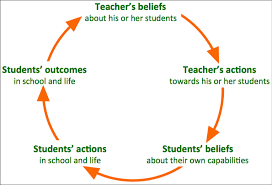 Today I came across this succinct article by Katie Martin on why believing in our students matters, as this can have a significant impact upon a teacher's practices and students' uptake of learning regardless of where learning and teaching that takes place - whether face-to-face or online.While I have known about the need to wait for responses from students for some time, and I value this approach, sometimes one can wait a bit too long. UK universities have had high and growing numbers of students from China for a while now. Some universities throw their doors open to International students since they pay higher fees.One such university near London where one Master's program of 150+ students has well over 95% of its students from China. At the same time, some of these same universities that seek to recruit large numbers of International students, often heavily reliant upon specific markets such as China, can, at times, lower the bar in terms of language requirements. From my own experience of observing and delivering teaching, this situation, which isn't unique to the aforementioned university, creates a number of issues since the students often:
- come with different levels of language readiness for an intensive postgraduate level of study;
- are not or may not be used to interacting and socializing with those from other countries;
- are unlikely to work outside their 'peer' group of compatriots due to shyness, peer pressure or do so begrudgingly; and/or
- lack confidence in their own abilities and are perhaps not provided with enough motivation from teaching staff to instill a positive, 'can-do' attitude to learning.
The result of any or a combination of these is that lecturers, academic tutors, learning developers and tutors of English for academic purposes are frequently put into tricky situations: the content has to be delivered, but if students are struggling to understand, what is to be done? Too often I have heard over the years, from staff at various institutions, similar negative remarks that Katie mentions in her article. I've always found these types of comments particularly demotivating and, silently, I ask myself upon hearing sustained negative comments "Well, why the hell are you in teaching?!" It is as if those making such comments were perfect students who always worked hard.On the flip side, the best colleagues I've had have always been positive, supportive and empathetic to the student journey. This empathy seems to set apart the negativity of the moaners from the teachers/lecturers whose lessons that we would always look forward to when we were once students. I think part of this empathy that some educators have is at least partially informed by the works of the Brazilian educationalist Paolo Freire, among others.Going back to Katie's article, I think one solution is creating a positive, welcoming environment that seeks to recognize the students as intelligent participants who are able to interact at Master's level successfully with regular, positive support that seeks to push the students' boundaries and to modify our teaching practices to engage the students in such a way that might tease out from them meaningful participation.One way, I believe, is to have a meaningful, welcoming induction to a program that gets students involved in getting to know their peers and teaching staff beyond the polite formalities of titles and names (think: basic teambuilding activities that get students to solve real problems related to their studies and/or life within their new educational setting). Oftentimes, I've seen inductions that were so superficially boring, stereotypical and/or dry that it immediately set the wrong (superficial) tone for the program of study in question.Another solution is to embed positive thinking throughout a program. As Katie says in her post:
... when we believe we can learn and improve through hard work and effort we can create the conditions and experiences that lead to increased achievement and improved outcomes.
In terms of learning and teaching, this is particularly powerful for our students. If they feel the above, they can and will improve in their learning journey. We, as educators, have a responsibility to instill these ideas into our students, especially International students who might genuinely need extra support, encouragement and motivation in order for them to become independent learners. Part of ensuring the success of our learners is to change our thinking - to think more positively, and to believe in our students.This also means we might need to change our approach to learning and teaching. So, for example, imagine you have a session of 15-50 students and they don't volunteer answers without being called on and prefer to stare at their phone or laptops (or both!). If our students are quiet and reticent to raise their hands to volunteer an answer, then there are some easily-doable solutions.
- Creating regularly-spaced questions to gauge/engage/formatively assess learning can significantly help improve participation, and these can be easily delivered via a response system such as Mentimeter or similar as students only need to use their mobile phone/phablet/tablet/laptop.
- Implementing a Twitter feed so that students can engage during/after a teaching session can also foster learning by using a module/course specific hashtag. These two blog posts have a range of good ideas:
Apart from those small solutions, I believe that part of ensuring the success of our learners is also to change our thinking - to think more positively, and to believe in our students. So, for example, rather than immediately assuming that most, if not all, International students are likely to plagiarize essays, we can set the stage from the start by building a positive, supportive environment that seeks to educate rather than pontificate. Another quote from Katie's article below underscores my message:
“When we expect certain behaviors of others, we are likely to act in ways that make the expected behavior more likely to occur. (Rosenthal and Babad, 1985)”
Let's take plagiarism. I've often heard from colleagues both genuine concerns and negative comments/expectations of students in terms of plagiarism. This, in turn, leads to plagiarism being approached in an almost compelling manner within course materials: plagiarism is bad, and therefore if you plagiarize you are bad and so if you plagiarize, you will fail, etc.Using the above example, one relatively simple way to embed a positive approach to learning and teaching is to change the negative, hellfire-and-damnation discourse on plagiarism often present within course materials to one that offers an open, frank discussion on attribution and giving credit. One such way I have done this is by getting students to look up and understand attribution through discussion, and then following this up by reading an in-depth report on a politician who plagiarized a paper for a Master's degree. From what I have observed, these combined approaches give students a chance to explore the issue of plagiarism through a more empowering lens while exercising their academic literacies (digital and information among others).From what I have observed, these combined approaches give students a chance to explore the issue of plagiarism through a more empowering lens while exercising their academic literacies (digital and information among others). It gets them thinking and talking amongst each other rather than being spoken [down] to in terms of the issues of plagiarism. Along with the teacher creating an empathic, positive atmosphere, this also makes students feel part of the discussion and (more) part of the academic community as they seek to understand expectations that may be new and/or alien to previous educational experiences.Ultimately, the choice lies with the teacher in question to change their practices or not. There is always an element of risk to transforming teaching practices. However, without taking risks (even small ones) to innovate, one will simply never know how effective the changes to might be. Mulling ideas over is a good way to get started, but as with anything, mulling ideas over for an extremely long amount of time can kill ideas and innovation. Staff who have ideas should be allowed to experiment, and line managers should be proactive in supporting staff who are enthustic about learning and teaching.If things don't entirely work as planned or expected, well, at least learning has occurred on the part of both the learners and the teacher(s) in question. The light bulb and radio weren't perfected within a day's time, so why should a new teaching approach be perfected before trying it out?! Just do it!Just do it!